AI for LP Reporting: What VC Firms Should Automate
Every quarter, venture capital firms repeat a familiar process.
Finance teams reconcile fund performance. Investment teams collect portfolio company updates. Partners review valuations and material developments. Investor relations teams bring everything together into a report that limited partners can understand.
The information often exists somewhere within the organization. The challenge is collecting it, verifying it, and presenting it consistently.
For a small venture capital fund, this process might involve a few spreadsheets, portfolio updates, and financial statements from the fund administrator.
For larger firms managing multiple funds, reporting can require information from dozens of portfolio companies, several accounting systems, and different internal teams.
Artificial intelligence creates an opportunity to reduce some of this repetitive work.
But there's an important distinction between using AI to prepare investor reporting materials and allowing AI to produce financial information independently.
AI for LP reporting works best when it automates information collection, validation checks, document preparation, and reporting workflows while keeping financial calculations and final approvals under human control.
The objective isn't to remove fund managers from the reporting process. It's to give them more time to review the information that matters.
What Is AI for LP Reporting?
AI for LP reporting refers to using artificial intelligence to assist with preparing, reviewing, and organizing information provided by venture capital firms to their limited partners.
Depending on the implementation, AI systems can help collect portfolio company updates, extract information from financial documents, identify missing data, prepare reporting commentary, and assemble draft investor reports.
These applications typically involve three types of technology.
Document processing models extract and organize information from financial statements, board decks, spreadsheets, and written updates.
AI research and language models help summarize approved information, compare reporting periods, and prepare narrative explanations.
AI agents can coordinate defined tasks across multiple steps, such as retrieving approved updates, checking information against reporting requirements, identifying gaps, and preparing materials for review.
The distinction matters because LP reporting is not simply a document-generation task.
A system might produce a well-written quarterly update while using outdated portfolio information or figures that haven't been approved.
That's why effective automation requires more than generating text.
It requires reliable data sources, defined reporting rules, access controls, and a clear approval process.
Why LP Reporting Remains a Manual Process for Many VC Firms
The biggest challenge in LP reporting isn't necessarily the complexity of writing a quarterly report.
It's the work required before the report can be written.
Consider a venture capital firm managing 35 portfolio companies across two funds.
Each portfolio company provides different financial and operational information. Some submit formal quarterly reports, while others share board presentations or spreadsheets.
The finance team maintains the fund's accounting records, while the investment team tracks company developments through meetings, emails, and internal notes.
Investor relations must reconcile those different sources into a consistent reporting package.
Even when the firm uses dedicated fund management software, several activities may remain manual.
Information Exists Across Different Systems
Portfolio information often lives in spreadsheets, document repositories, CRMs, and portfolio monitoring platforms.
Fund-level financial information may be maintained separately by an administrator or accounting system.
Collecting this information for quarterly reporting requires coordination across systems and teams.
Reporting Formats Aren't Consistent
Different portfolio companies report different metrics.
A SaaS company may focus on ARR, net revenue retention, and customer acquisition.
A hardware company may report production milestones, inventory levels, and gross margins.
A biotechnology company may prioritize clinical milestones, research spending, and regulatory progress.
Combining these updates into one reporting package requires an understanding of each company's business model.
Financial Information Requires Verification
Fund performance figures must come from the appropriate accounting and valuation processes.
Portfolio company operating metrics should also be checked against their original reporting sources.
An outdated number can create inconsistencies between the investor report and the firm's approved records.
Reporting Requires Multiple Approvals
Finance teams, investment professionals, and managing partners may each be responsible for different parts of the report.
A system that produces a draft quickly but doesn't support those review requirements may create additional work rather than reduce it.
These are the areas where AI can provide practical value.
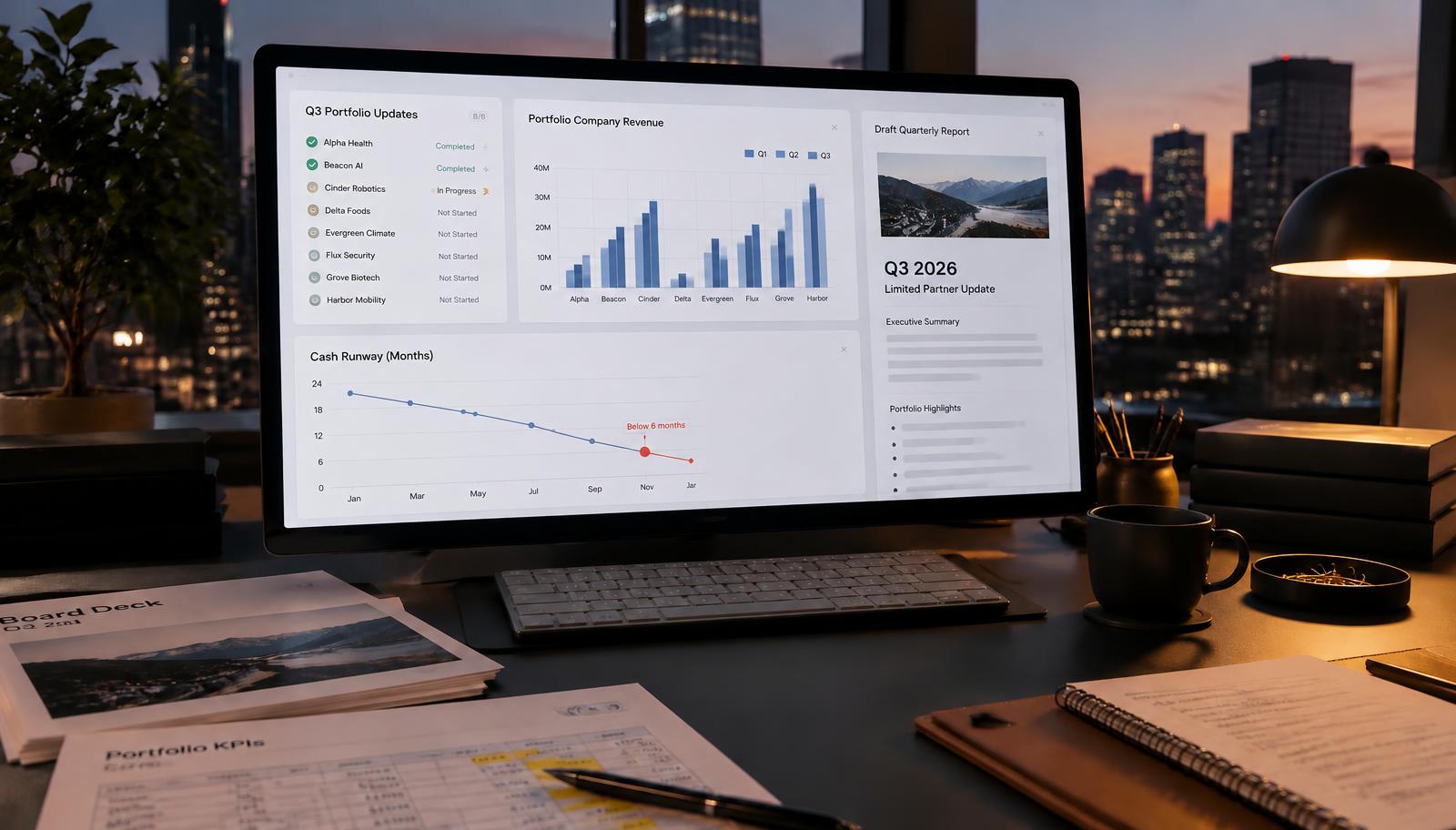
5 LP Reporting Workflows Venture Capital Firms Can Automate With AI
Not every reporting activity should be automated.
The strongest opportunities are repetitive processes that involve collecting, organizing, checking, and preparing information already available to the firm.
1. Collecting Portfolio Company Updates
Portfolio company data collection is one of the most practical applications of AI in venture capital reporting.
Investment teams regularly receive updates containing financial metrics, hiring developments, operating milestones, and fundraising information.
These updates may arrive as PDFs, spreadsheets, board decks, or written summaries.
AI-assisted document processing can help extract relevant information and organize it into consistent records.
For example, a system might identify:
- Reported revenue and revenue growth
- Cash balances and burn rates
- Cash runway
- Headcount changes
- Financing developments
- Major operating milestones
- Outstanding risks or management concerns
The extracted information can then be presented for review.
Importantly, the system should retain the source document, reporting period, and metric definition.
A cash balance reported three months ago should not automatically be treated as the company's current position.
For firms managing large portfolios, this process can make information collection more consistent.
However, the investment team must still verify material information before it is used in investor communications.
Our article on AI tools for VC portfolio management examines how artificial intelligence can support portfolio monitoring, KPI tracking, and reporting workflows.
2. Identifying Missing or Inconsistent Reporting Information
Collecting information is only the first step.
Before preparing an LP report, the investment team needs to know whether the available information is complete and reliable.
AI can assist by checking submitted materials against the firm's reporting requirements.
For example, a system could identify when:
- A portfolio company hasn't submitted its quarterly update.
- Financial information is missing for a reporting period.
- A metric differs significantly from the previous quarter.
- Two documents contain conflicting figures.
- A company's reporting methodology has changed.
- An investment update references information that hasn't been verified.
Consider a portfolio company reporting 14 months of cash runway in its board presentation while its latest financial spreadsheet suggests 11 months.
An AI system could flag the discrepancy and identify the documents containing the different figures.
It should not independently decide which number is correct.
Instead, it should provide enough context for the responsible team to investigate and resolve the discrepancy.
The value of AI in this workflow comes from identifying exceptions, not automatically assuming that the information is accurate.
3. Preparing Quarterly Portfolio Commentary
LP reports often include narrative updates explaining portfolio developments.
This information goes beyond financial statements.
Limited partners may want to understand which companies are progressing, which investments face challenges, and what developments may affect the fund's outlook.
Preparing these summaries requires reviewing company updates, previous reports, and internal investment information.
AI can assist by organizing approved information into draft commentary.
For example, an AI workflow might prepare a quarterly summary covering:
Company performance: Important financial and operating developments.
Business milestones: Product launches, expansion activities, or other material events.
Financing activity: New rounds, follow-on investments, or relevant funding developments.
Risks: Material developments requiring monitoring.
Changes since the previous quarter: Information that helps investors understand what has improved or deteriorated.
The investment team would then review the draft, confirm the facts, and provide the interpretation.
This distinction is important.
AI may recognize that revenue increased during the quarter, but that doesn't necessarily mean the investment is performing according to expectations.
The growth may be below plan. The company may be spending substantially more to generate that revenue. Or the change may reflect an accounting adjustment.
The GP's responsibility is to explain what the information means in the context of the investment.
Research from the European venture capital community reinforces this distinction.
In October 2026, EUVC published preliminary findings from its LP Trust Report indicating that more than 75% of surveyed respondents were comfortable with AI-assisted quarterly reporting when the GP retained responsibility for the final output.
The findings are preliminary and based on an ongoing survey rather than a representative study of all limited partners.
Nevertheless, they highlight an important consideration: AI assistance and GP accountability are not mutually exclusive.
EUVC's preliminary LP reporting research also emphasizes the importance of explaining investment performance rather than simply presenting portfolio data.
4. Assembling Draft LP Reporting Packages
Quarterly reporting involves bringing together financial information, portfolio commentary, investment activity, and other required disclosures.
AI agents can help coordinate parts of this process.
For example, an agent could be configured to retrieve approved inputs, check whether required documents are available, and prepare a draft reporting package using the firm's established format.
A typical reporting package may contain:
- Executive summary
- Fund performance overview
- Portfolio company developments
- Investment and exit activity
- Capital account information
- Management commentary
- Relevant financial statements
- Additional fund-specific disclosures
The exact contents depend on the fund's governing documents, investor obligations, and reporting framework.
AI can help organize the approved inputs and identify missing sections.
However, financial statements, capital account balances, and performance calculations should originate from authoritative financial records and remain subject to the firm's established controls.
The Invest Europe Investor Reporting Guidelines provide a useful reference for the types of information commonly included in private capital investor reporting.
These guidelines distinguish fund-level information, portfolio information, and investor-specific records.
That separation is relevant when designing automated reporting workflows.
An AI system should understand which information belongs in each section and which source is responsible for providing it.
5. Maintaining Historical Reporting and Institutional Knowledge
LP reporting doesn't end when the quarterly report is distributed.
Investment teams frequently need to retrieve information from previous reporting periods.
A managing partner may want to understand how a particular company's outlook has changed over the past year.
An LP may ask why an investment's reported value changed between quarters.
A new finance team member may need to locate the assumptions behind a previous portfolio commentary section.
When historical information is scattered across documents and emails, answering these questions can require considerable manual research.
AI-supported knowledge systems can make approved reporting history easier to retrieve.
For example, a system could help users locate previous quarterly commentary, identify changes in reported metrics, and retrieve the supporting documents.
However, historical records should retain their original dates, context, and approval status.
The objective isn't to rewrite previous investment decisions.
It's to make the reasoning and information behind those decisions accessible to authorized team members.
This is one potential application of Sonexa Labs' Institutional Knowledge & Firm Operations offering.
What AI Should Not Automate in LP Reporting
There is a significant difference between automating report preparation and automating financial accountability.
Some activities require controls that should not be delegated to an AI system without appropriate human validation and authorization.
| Reporting Activity | Appropriate AI Role | Required Human Responsibility |
|---|---|---|
| Portfolio data extraction | Extract and organize submitted information | Verify material figures |
| Reporting completeness | Identify missing documents and discrepancies | Resolve exceptions |
| Portfolio commentary | Prepare drafts from approved sources | Interpret developments and approve narrative |
| Fund performance calculations | Retrieve and check approved outputs | Maintain authoritative calculations and review |
| Investment valuations | Organize supporting evidence | Apply valuation policy and approve valuations |
| Capital account statements | Assemble approved information | Reconcile and authorize statements |
| LP report distribution | Prepare documents for distribution | Approve recipients, permissions, and final release |
Investment Valuations Require Professional Judgment
Private market valuations can involve uncertainty, particularly when portfolio companies don't have readily observable market prices.
The International Private Equity and Venture Capital Valuation Guidelines establish widely used principles for determining fair value in private capital investments.
The guidelines were updated in December 2025.
AI can assist in organizing valuation evidence, identifying relevant financial information, or highlighting changes in assumptions.
However, it should not independently approve portfolio valuations.
Those decisions must follow the fund's valuation policies, applicable accounting framework, and governance requirements.
Fund Performance Figures Need an Authoritative Source
Metrics such as IRR, TVPI, and DPI should be calculated using the appropriate financial records and methodologies.
A language model should not be treated as an authoritative accounting engine.
It may assist with retrieving approved calculations or checking consistency between documents.
But the responsible finance team must ensure the figures are accurate and appropriately presented.
Confidential Investor Information Requires Access Controls
LP reporting often includes sensitive information about fund performance, investors, portfolio companies, and internal investment decisions.
AI systems must operate within approved information-access boundaries.
A reporting workflow should not expose one investor's confidential information to another investor or retrieve data beyond an authorized user's permissions.
These considerations should be addressed before introducing AI into live financial reporting processes.
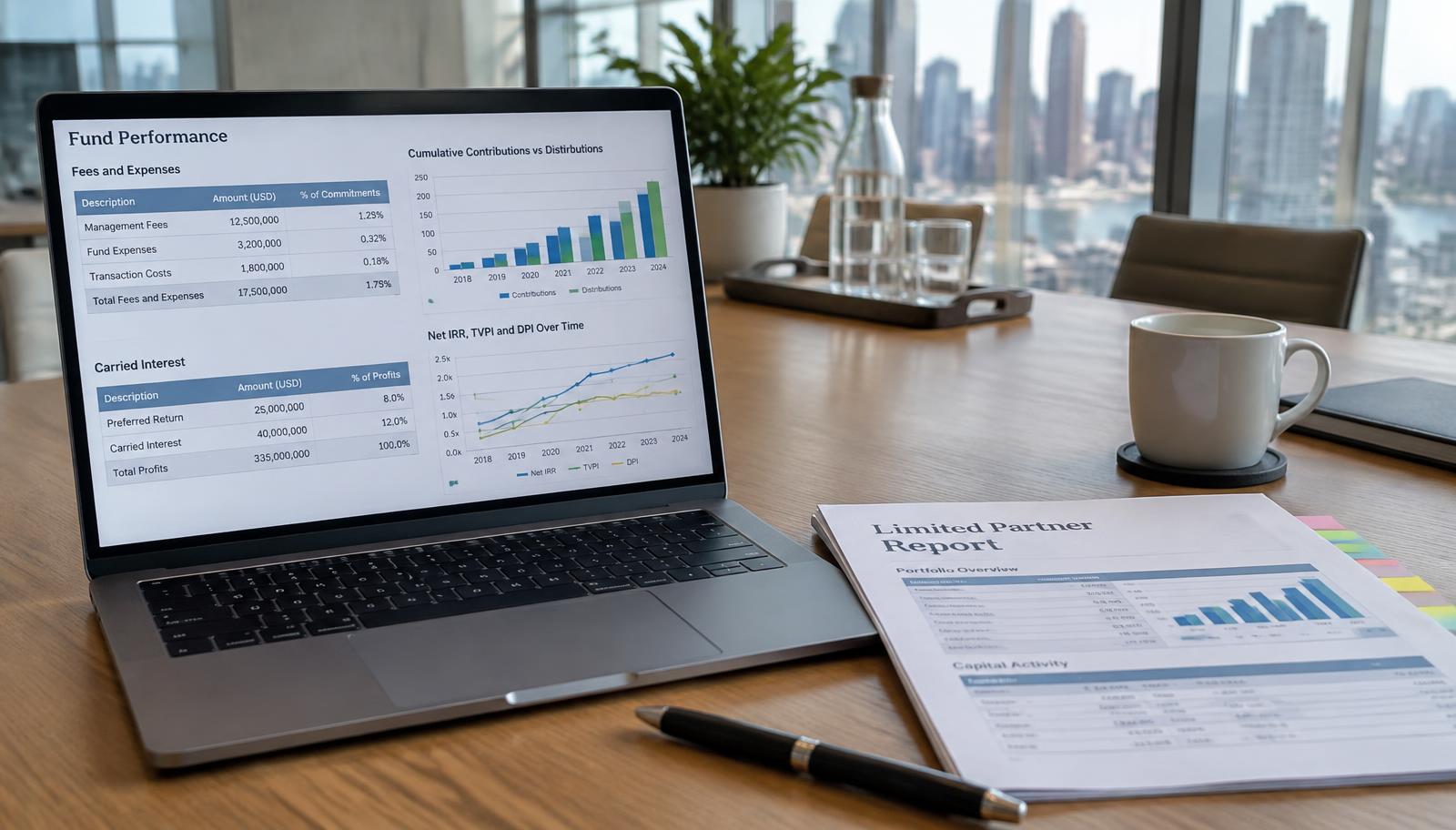
AI for LP Reporting and the 2026 ILPA Standards
Reporting standardization is an important consideration for venture capital firms evaluating AI automation.
The Institutional Limited Partners Association released updated reporting standards in January 2025, including its Reporting Template and Performance Template.
The updated ILPA Reporting Template is intended to improve consistency in reporting fees, expenses, and carried interest.
It is intended for funds still in their investment period during Q1 2026 or commencing operations on or after January 1, 2026.
The ILPA Performance Template provides a framework for standardized performance calculations and supporting cash-flow information.
It applies prospectively to funds commencing operations on or after January 1, 2026.
These templates supplement the financial statements and other reporting requirements established by the fund's governing documents and applicable accounting or regulatory obligations.
How AI Fits Into Standardized Reporting
The value of standardized reporting is that it establishes consistent expectations about the information being provided.
AI can assist by checking whether required information is available, organizing source documents, and preparing draft sections according to a defined reporting structure.
For example, an AI workflow could compare a reporting package against the firm's applicable template and flag missing information.
However, AI-generated reporting does not automatically establish ILPA compliance.
The responsible team must confirm that the reporting methodology, financial information, and disclosures satisfy the relevant requirements.
This is particularly important when a firm is adopting new reporting templates or operating across several jurisdictions.
How an AI-Powered LP Reporting Workflow Could Work
For venture capital firms considering automation, the starting point should be the existing reporting process.
Consider a hypothetical seed-stage fund managing 30 portfolio companies.
The fund already uses an administrator for accounting and maintains company updates in a separate portfolio monitoring system.
Its biggest reporting challenge is preparing quarterly portfolio commentary and ensuring the information is consistent.
A fund-specific AI workflow could be designed around six stages.
| Stage | Workflow | Responsibility |
|---|---|---|
| 1 | Retrieve approved portfolio updates | AI-assisted collection |
| 2 | Extract relevant financial and operational information | AI-assisted processing |
| 3 | Identify missing data and conflicting figures | Automated checks and human resolution |
| 4 | Prepare draft portfolio commentary | AI-generated draft |
| 5 | Reconcile against approved reporting records | Finance and investment team review |
| 6 | Approve and distribute the reporting package | Authorized human approval |
Step 1: Connect Approved Data Sources
The workflow begins by identifying which systems contain information that can be used for reporting.
This may include portfolio monitoring tools, approved company reports, internal documents, and accounting records.
Access should be limited to the information required for the task.
Step 2: Organize the Information
The system extracts relevant data and associates it with the appropriate company and reporting period.
For example, it might identify revenue growth and cash runway figures from a portfolio company's quarterly report.
The original source remains available for verification.
Step 3: Identify Exceptions
The system checks for missing information, inconsistent reporting periods, and conflicting figures.
Exceptions are flagged for review rather than automatically resolved.
Step 4: Generate Draft Commentary
Once the information has been reviewed, AI prepares draft portfolio summaries using the fund's reporting format.
The output should distinguish confirmed information from unresolved questions.
Step 5: Review and Reconcile
Investment professionals validate company developments and the interpretation of performance.
Finance professionals confirm that any fund-level financial information matches approved accounting records.
Step 6: Approve the Final Report
The completed reporting package moves through the firm's established approval process before distribution.
The AI system assists with preparation, but the firm retains responsibility for the final information provided to LPs.
This approach introduces automation without changing who is accountable for investor reporting.
Should VC Firms Use Existing LP Reporting Software or Build Custom AI Workflows?
Not every venture capital firm needs a custom AI system.
Many existing platforms already provide fund reporting, investor portals, financial information management, and recurring reporting capabilities.
For firms primarily seeking standardized investor reporting, these platforms may be sufficient.
Our comparison of LP reporting software for venture capital firms examines the differences between reporting platforms and the capabilities investment teams should evaluate.
However, the situation becomes more complicated when a firm's reporting process involves several systems and fund-specific requirements.
When Existing Software May Be Sufficient
A standardized platform may be appropriate when the firm needs:
- Fund accounting and performance reports
- Investor statements
- Secure LP portals
- Standard reporting templates
- Capital call and distribution workflows
- Recurring document delivery
These are established software categories with specialized providers.
When Tailored AI May Be Worth Evaluating
A custom AI workflow becomes more relevant when the firm needs to coordinate information across several systems or apply requirements specific to its internal processes.
For example, a firm may want to combine approved portfolio updates with historical reporting commentary and its own internal review procedures.
Another may need a workflow that identifies information gaps before the quarterly reporting process begins.
A third may want to maintain searchable institutional knowledge across multiple funds and reporting periods.
These requirements can justify a tailored implementation when the operational benefits outweigh development and maintenance costs.
The important distinction is that a tailored AI system should address a specific workflow rather than attempt to replace every existing reporting application.

How Sonexa Labs Approaches AI for LP Reporting
Sonexa Labs develops fund-specific AI models and agents around venture capital firms' investment strategies, data, and internal operating processes.
Through its Fund Operations & LP Reporting offering, Sonexa can scope AI systems around defined reporting and operational requirements.
Rather than requiring every venture capital firm to adopt the same workflow, an engagement begins with understanding the firm's existing process.
For example, a fund may want to reduce the work involved in collecting portfolio updates, identifying reporting gaps, and preparing quarterly investment commentary.
A commissioned system could be designed to support those activities using approved information sources, structured outputs, and defined review procedures.
The exact capabilities would depend on the firm's requirements, available data, permissions, and agreed deliverables.
Sonexa's broader Tailored Solutions approach also allows firms to evaluate related workflows involving portfolio intelligence and institutional knowledge.
These are commissioned systems, not standard features automatically included in Juno or another standalone product.
The objective is to help the firm improve repeatable reporting activities while keeping investment judgment, financial controls, and final approvals with the appropriate professionals.
How to Measure the Value of AI LP Reporting Automation
The effectiveness of an AI reporting system should be measured against the firm's existing process.
Producing a report quickly is not necessarily an improvement if the output requires substantial corrections.
A better evaluation considers both the amount of work reduced and the reliability of the final information.
Useful measurements include:
| Measurement | What It Reveals |
|---|---|
| Reporting preparation time | Whether automation reduces repetitive work |
| Missing-information rate | Whether required inputs are collected consistently |
| Data extraction accuracy | Whether information is correctly captured |
| Human correction rate | How much work remains after AI preparation |
| Reporting revision cycles | Whether drafts require fewer rounds of corrections |
| Source traceability | Whether material statements can be verified |
| On-time reporting | Whether the process supports reporting deadlines |
| Team adoption | Whether finance and investment teams actually use the workflow |
For example, a firm might compare two quarterly reporting cycles using the same preparation and review requirements.
The evaluation should include the time spent correcting AI-generated output, not just the time required to produce the initial draft.
It should also account for the cost of maintaining the system, validating information, and managing integrations.
A useful AI implementation is one that improves the complete reporting workflow, not merely one step within it.
Conclusion: Automate the Preparation, Not the Accountability
AI can make venture capital LP reporting more efficient, but its value depends on where it is applied.
Collecting portfolio updates, identifying missing information, organizing historical records, and preparing draft commentary are practical opportunities for automation.
Financial calculations, valuations, investor-specific disclosures, and final reporting approvals require stronger controls and professional oversight.
The most effective approach is to start with an existing reporting bottleneck, establish reliable information sources, and introduce automation where it can produce measurable improvements.
For venture capital firms with specialized reporting requirements, fund-specific AI systems can provide another way to improve existing workflows without replacing established financial controls.
Sonexa Labs develops AI models and agents around venture capital firms' investment and operational processes, including portfolio intelligence, fund operations, and LP reporting.
Book a Demo to explore how a tailored AI system could support your firm's reporting workflows.
Frequently Asked Questions
Can AI automate LP reporting for venture capital firms?
Yes. AI can automate selected tasks such as collecting portfolio company updates, extracting financial information, identifying missing data, preparing draft commentary, and organizing reporting materials. Financial figures and final reports should remain subject to appropriate verification and approval.
What is AI for LP reporting?
AI for LP reporting involves using artificial intelligence to assist with preparing, reviewing, and organizing information provided to limited partners. Applications may include document processing, portfolio data extraction, automated checks, narrative drafting, and reporting workflow coordination.
Can AI generate quarterly LP reports?
AI can generate draft quarterly reporting materials using approved information. However, financial statements, fund performance calculations, and investor-specific disclosures should be validated against authoritative records before distribution.
What are the benefits of AI LP reporting automation?
Potential benefits include reduced manual data collection, more consistent reporting preparation, earlier identification of missing information, and improved access to historical records. Actual results depend on the quality of the underlying data and the design of the workflow.
Is AI-generated LP reporting compliant with ILPA standards?
Not automatically. AI may help prepare information according to ILPA reporting templates, but firms must verify that the reporting methodology, calculations, and disclosures satisfy the applicable standards and their own reporting obligations.
Can AI calculate IRR, TVPI, and DPI?
AI-enabled systems can help retrieve, organize, or check performance information. However, authoritative calculations should be produced and validated using the fund's approved accounting records and established calculation methodologies.
Does a VC firm need custom AI to automate LP reporting?
Not necessarily. Many reporting and fund administration platforms already automate common reporting activities. Custom AI becomes more relevant when a firm has specialized requirements or needs to coordinate workflows across multiple systems.
How does Sonexa Labs support AI-powered LP reporting?
Sonexa Labs develops commissioned AI models and agents around individual venture capital firms' workflows. A tailored engagement could address portfolio information collection, reporting preparation, data validation checks, or institutional knowledge retrieval, depending on the agreed scope.