LP Reporting Tools for VC Firms: What Matters Most
Quarterly LP reporting is one of those responsibilities that looks straightforward until a venture capital firm starts managing multiple funds, dozens of portfolio companies, and investors with different reporting requirements.
Portfolio updates arrive in different formats. Fund performance data needs to be reconciled. Capital account statements must reflect the correct transactions. Partners want commentary that explains what happened during the quarter, while limited partners expect accurate information delivered on time.
For smaller venture capital firms, much of this work still involves spreadsheets, shared documents, emails, and information pulled from different systems.
As portfolios grow, the amount of coordination required can increase considerably.
This is where LP reporting software becomes valuable.
But selecting the right platform is not simply a matter of choosing the product with the most reporting features.
Some tools specialize in fund accounting and investor statements. Others focus on portfolio company reporting, investor communications, or delivering documents through secure portals.
Understanding those differences is essential.
This article examines the LP reporting tools for VC firms worth evaluating in 2026, the capabilities that matter most, and how investment teams can choose software that fits their reporting requirements.
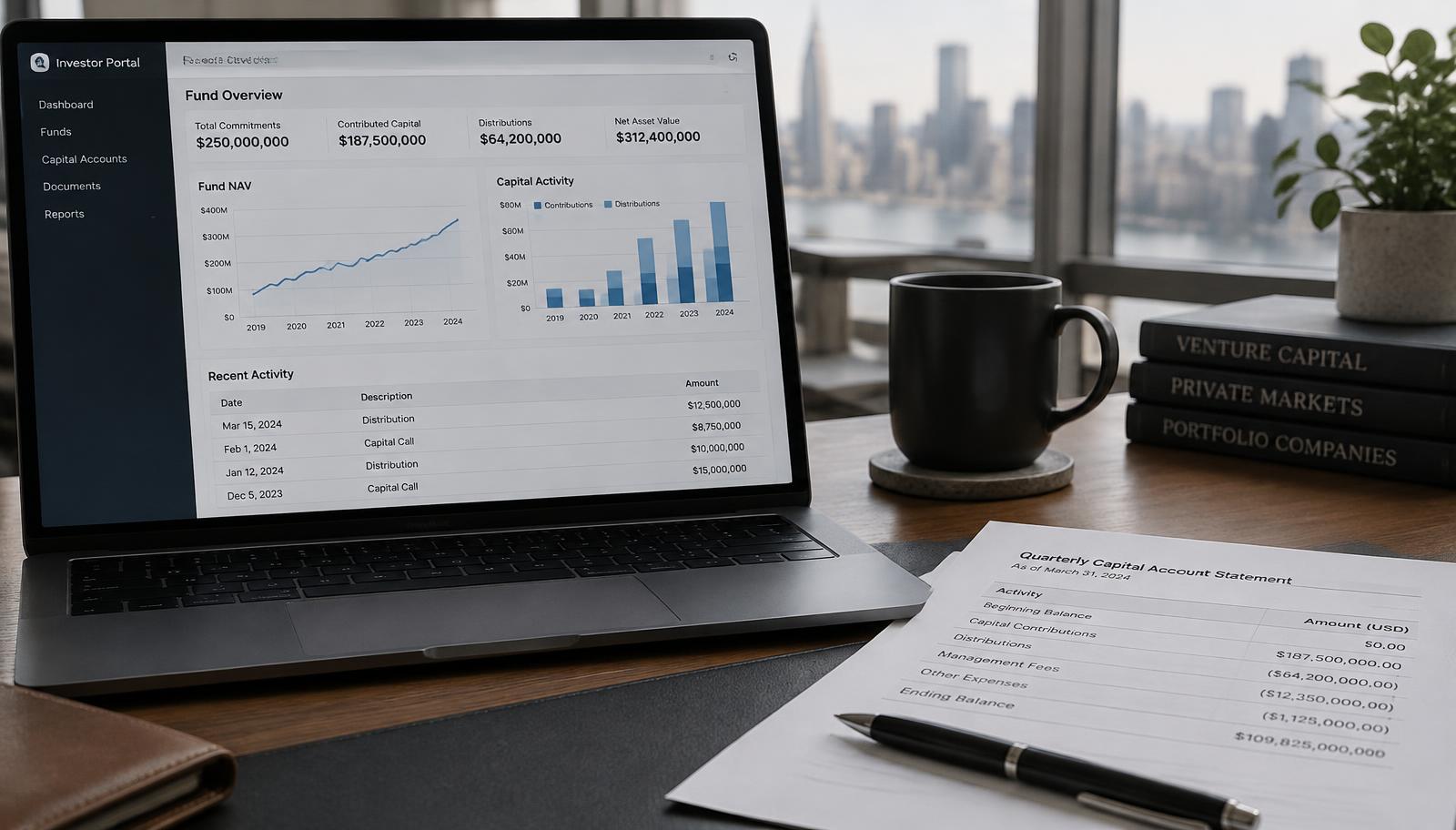
What Are LP Reporting Tools for Venture Capital Firms?
LP reporting tools are software platforms that help venture capital firms prepare, organize, and distribute information to their limited partners.
Depending on the platform, they can support fund performance reporting, financial statements, capital account information, portfolio updates, investor communications, and secure document distribution.
The purpose is to make information easier to prepare, validate, and share throughout the fund's lifecycle.
However, LP reporting software is not one single category of technology.
Three categories are particularly relevant.
Fund Accounting and Financial Reporting Platforms
These systems maintain or process the financial information needed for fund reporting.
They may support capital account calculations, investment valuations, fund expenses, allocations, and performance reporting.
For firms managing multiple investment vehicles, the ability to maintain accurate fund-level financial records is particularly important.
Investor Relations and Reporting Platforms
Investor relations platforms focus on how information is delivered to limited partners.
This often includes investor portals, document management, communications, reporting distribution, and investor-specific access permissions.
Some platforms provide these capabilities alongside fund accounting, while others rely on external administrators or accounting systems for the underlying figures.
Portfolio Monitoring and Reporting Platforms
Portfolio monitoring platforms help investment teams collect financial and operating information from portfolio companies.
This may include revenue, cash burn, runway, operating milestones, and other KPIs.
The information can support LP updates and portfolio commentary.
However, collecting company metrics is different from calculating fund returns or preparing authoritative capital account statements.
A venture capital firm may need more than one category of software to support its complete LP reporting process.
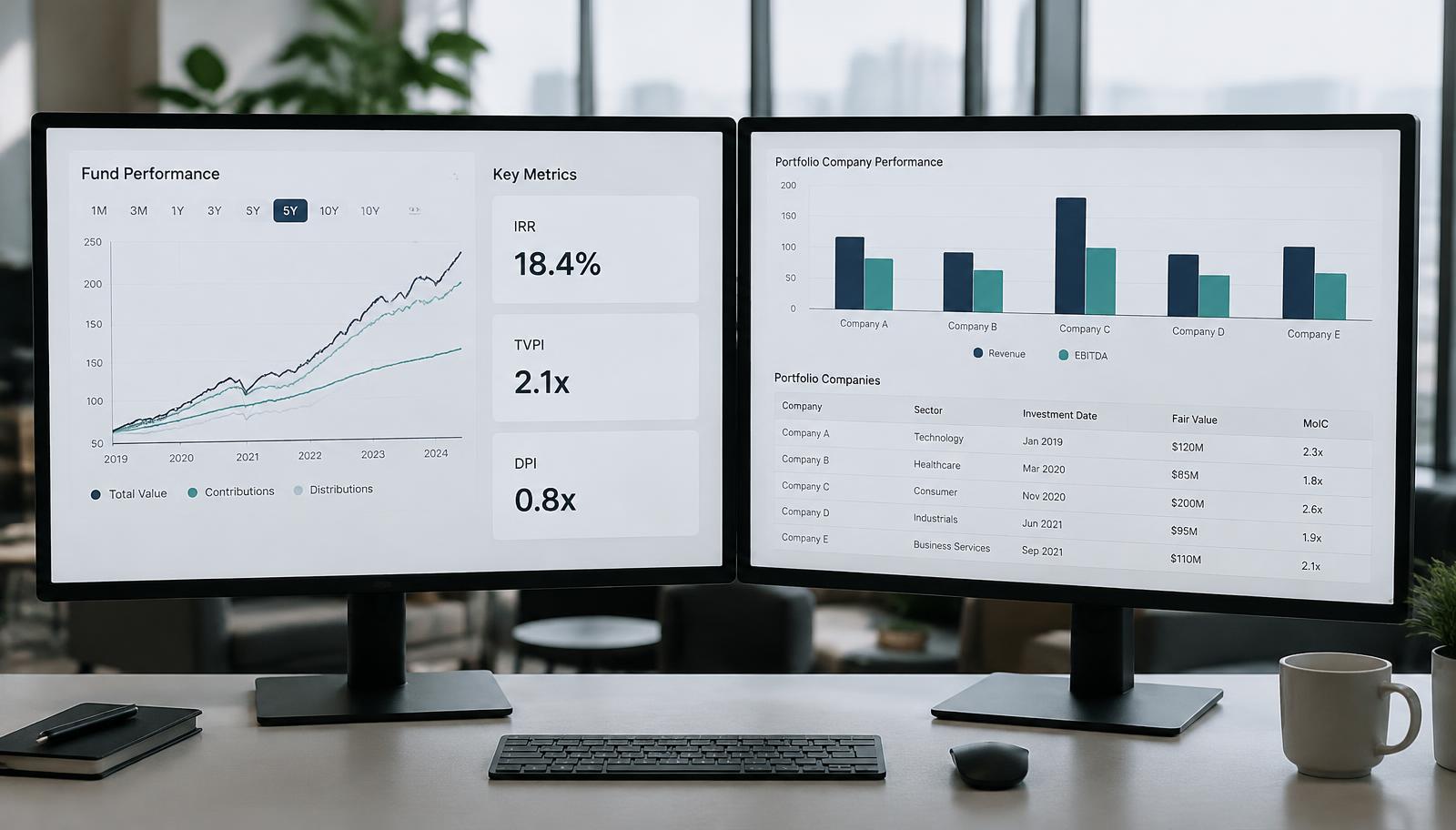
LP Reporting Software Compared: Five Platforms Worth Evaluating
Several established platforms support different parts of the venture capital reporting process.
The following comparison focuses on Carta, Juniper Square, Allvue, Dynamo, and Visible.
Each offers a different combination of financial reporting, investor relations, portfolio monitoring, and fund administration capabilities.
| Platform | Primary Focus | Relevant LP Reporting Capabilities | Considerations |
|---|---|---|---|
| Carta | Fund administration and accounting | Fund financial information, LP portal, performance reporting, investor documents | Evaluate the scope of bundled administration services |
| Juniper Square | Investor operations and fund administration | Investor reporting, capital activity, secure portal, investor communications | Assess implementation and integration requirements |
| Allvue | Fund accounting and investor reporting | Financial reporting, investor statements, reporting distribution, configurable dashboards | Configuration and operational complexity |
| Dynamo | Investment and fund operations | Investor relations, fund accounting, portfolio information, reporting workflows | Confirm required modules and integration depth |
| Visible | Portfolio monitoring and reporting | Portfolio dashboards, company metrics, LP tear sheets, reporting materials | Not a direct replacement for fund accounting |
The comparison is based on vendor-published capabilities. It is not an independently tested ranking, and functionality may vary by product package or implementation.
1. Carta: Connecting Fund Administration With LP Reporting
Carta provides fund administration and financial management services for venture capital and other private market funds.
Its platform connects fund accounting activities with investor reporting and fund performance information.
For venture capital managers, this is relevant because the numbers used in LP reporting often originate from several financial processes.
Capital contributions, distributions, investments, expenses, and valuations all affect the information presented to investors.
Relevant capabilities include:
- Fund accounting and administration
- Fund performance reporting
- Investment and valuation tracking
- Capital call and distribution workflows
- Investor document management
- Secure LP portal
- Investor-level financial information
Carta's investor portal allows LPs to access information such as commitments, contributions, net asset balances, and fund-related documents.
Where Carta fits
Carta is worth evaluating for emerging and established venture capital managers who want financial administration and investor reporting supported within a connected environment.
For example, a fund using Carta for administration may be able to reduce the number of separate systems required to prepare financial reporting packages.
What to evaluate
Firms should clarify which reporting activities are performed by Carta's administration team, which are available directly through the software, and which require additional services.
They should also confirm whether their fund's particular investment structures and reporting obligations are supported.
2. Juniper Square: Investor Reporting and LP Experience
Juniper Square provides software and services for private markets fund operations, including investor relations, fund administration, reporting, and investor communications.
Its offering places significant emphasis on the experience limited partners have when accessing information about their investments.
Rather than distributing documents through disconnected email threads, firms can maintain investor information and communications within a centralized environment.
Relevant capabilities include:
- Secure investor portal
- Investor reporting and document distribution
- Capital call and distribution workflows
- Investor onboarding
- Fund administration services
- Performance and asset reporting
- Investor communications
- Reporting access controls
Where Juniper Square fits
Juniper Square is particularly relevant for firms that want to improve both the production and delivery of investor information.
Consider a venture capital firm managing several funds with overlapping LP relationships.
An investor may have commitments to multiple vehicles and need access to different documents, statements, and communications.
A centralized reporting environment can make that experience easier to manage.
What to evaluate
Firms should assess how Juniper Square connects reporting data with their existing accounting records.
They should also confirm which workflows are included in the software and which depend on bundled fund administration services.
For firms with existing administrators, integration and data ownership should be evaluated before introducing another platform.
3. Allvue: Financial Reporting and Fund-Level Control
Allvue provides investment management software for private capital firms, including venture capital, private equity, and other alternative investment strategies.
Its platform offers fund accounting, investment accounting, investor portals, and reporting capabilities.
The emphasis on financial systems makes Allvue relevant for firms that need more structured reporting processes.
Relevant capabilities include:
- Fund accounting
- Investor statements
- Capital call and distribution notices
- Financial reporting
- Investor portal
- Report distribution
- Configurable reporting dashboards
- Integration with accounting information
Where Allvue fits
Allvue is worth evaluating when a firm needs tighter coordination between its accounting records and investor reporting.
For example, a multi-fund venture capital manager may need to prepare reports for several investment vehicles, each with different capital accounts and financial activity.
Maintaining consistent financial information becomes increasingly important as the reporting environment grows more complex.
What to evaluate
The firm should understand the configuration requirements, implementation process, and level of operational support needed.
It should also test whether reporting can be produced directly from approved accounting records without introducing additional manual reconciliation.
4. Dynamo: Connecting Investor Relations and Fund Operations
Dynamo provides investment management software for general partners and limited partners across alternative asset classes.
Its platform covers a broader range of investment operations, including investor relations, portfolio management, fund accounting, and reporting.
This makes it relevant for firms seeking to connect financial information with investor communications and other internal workflows.
Relevant capabilities include:
- Investor relationship management
- Fund accounting and administration capabilities
- Portfolio monitoring
- Reporting and analytics
- Investor portal functionality
- Document management
- Fund operations workflows
- AI-assisted data and operational processes
Where Dynamo fits
Dynamo may appeal to firms seeking a broader operating platform rather than a standalone reporting tool.
For example, a venture firm may want its finance and investor relations teams to work with consistent information while maintaining visibility into reporting deadlines and investor requests.
Connecting these activities can reduce fragmentation between teams.
What to evaluate
Because Dynamo covers multiple operational functions, firms should verify which components are required for LP reporting and how those modules exchange information.
They should also assess the operational effort involved in maintaining the platform.
5. Visible: Portfolio Reporting and LP Communications
Visible approaches LP reporting from a different direction.
Rather than centering its offering on fund administration, Visible focuses on collecting and organizing portfolio company information.
That information can then support portfolio monitoring, internal investment reviews, and LP-facing reporting materials.
Relevant capabilities include:
- Portfolio company data collection
- KPI monitoring
- Portfolio dashboards
- Fund performance information
- LP tear sheets
- Portfolio reporting
- Reporting automation
- AI-assisted data processing
Where Visible fits
Visible is relevant when the biggest LP reporting bottleneck is collecting information from portfolio companies.
Consider a seed-stage firm with 40 portfolio companies.
Each company submits updates through different documents, spreadsheets, and reporting schedules.
Before the investment team can explain portfolio developments to LPs, it needs to consolidate that information.
Visible helps address this reporting workflow.
What to evaluate
Firms should distinguish between portfolio reporting and fund accounting.
A platform that produces portfolio company tear sheets may not provide all the accounting controls, investor allocations, or financial statement functionality required for a complete LP reporting package.
Visible may therefore complement a fund administration platform rather than replace it.
For a broader discussion of portfolio monitoring platforms, see our comparison of VC portfolio management software.
What Should VC Firms Actually Look for in LP Reporting Software?
Comparing software features is useful, but selecting a platform should begin with the reporting requirements of the fund.
The most important question is not which tool produces the most polished dashboard.
It is whether the system can produce reliable information and make the reporting process easier to manage.
1. Fund-Level Financial Reporting
LPs need accurate information about the performance and financial position of the fund.
Depending on the fund and its reporting obligations, this can include:
- Net asset value
- Capital contributions and distributions
- Unfunded commitments
- Investment valuations
- Management fees and fund expenses
- Carried interest
- Fund performance metrics such as IRR, TVPI, and DPI
- Capital account statements
A reporting platform should obtain these figures from the appropriate financial records.
If a firm maintains its accounting in another system, the reporting software must have a reliable process for receiving and reconciling that information.
2. Standardized Reporting and ILPA Alignment
Reporting consistency has become an important consideration for private market investors.
The Institutional Limited Partners Association has developed standardized reporting frameworks intended to improve transparency and comparability.
In January 2025, ILPA released an updated Reporting Template and a new Performance Template, with implementation guidance relevant to reporting from 2026 onward.
The updated ILPA Reporting Template focuses on consistent reporting of fees, expenses, and carried interest.
The ILPA Performance Template addresses standardized return calculation methodologies and associated cash flows.
These are distinct reporting frameworks, and their applicable timelines differ.
The Reporting Template is intended for funds still in their investment period during Q1 2026 or commencing operations on or after January 1, 2026.
The new Performance Template applies prospectively to funds commencing operations on or after January 1, 2026.
These industry templates do not automatically replace a fund's contractual, accounting, or regulatory obligations.
When evaluating LP reporting tools, firms should ask whether the software supports the relevant ILPA templates and how the reporting fields map to the fund's accounting records.
A vendor's general claim of ILPA compatibility should not replace a review of the actual reporting output.
3. Portfolio Company Reporting
Financial reporting explains how the fund is performing.
Portfolio company reporting helps explain what is happening within the underlying investments.
For venture capital firms, this may include revenue growth, cash runway, operating milestones, financing developments, and other company-specific information.
The challenge is maintaining consistent information across companies with different business models.
A SaaS company and a biotechnology company may have entirely different performance indicators.
A useful reporting platform should accommodate these differences rather than force every company into the same metrics.
AI-assisted portfolio monitoring can help with collecting and structuring information.
Our article on AI tools for VC portfolio management examines how these workflows can be automated while preserving data validation and investor oversight.
4. Secure Investor Portals
An investor portal is often the most visible part of an LP reporting platform.
It allows limited partners to access approved documents and information without depending entirely on email.
However, the portal's design is only one consideration.
Firms should evaluate whether it supports investor-specific permissions, document access controls, historical reporting, secure distribution, and appropriate authentication.
A limited partner should only be able to access information they are authorized to receive.
For firms managing multiple vehicles, permission controls become particularly important.
5. Reporting Accuracy and Auditability
One of the biggest risks in investor reporting is distributing information that has not been properly reconciled or approved.
For example, an LP report might use an outdated investment valuation while the finance team maintains a more recent approved figure.
Alternatively, portfolio commentary may contain company information that has not yet been validated.
Reporting systems should make it possible to identify the source of material figures, distinguish drafts from approved information, and maintain records of changes.
This is particularly important when evaluating tools that use AI to extract or summarize information.
Automation can reduce preparation work, but it does not eliminate the need for review.
For a step-by-step review process, see our guide to LP reporting accuracy.
6. Integration With Existing Fund Systems
A venture capital firm may already use separate platforms for:
- Fund accounting
- Portfolio monitoring
- CRM and investor relations
- Investment research
- Document management
- Financial reporting
Introducing another application should not require the team to recreate the same information manually.
Instead, firms should determine which system is authoritative for each category of data and how information moves between systems.
For example, approved fund accounting records should remain the authoritative source for financial statements.
Portfolio monitoring software may supply company operating information, while the investor relations platform manages distribution.
A well-defined process helps prevent inconsistent reporting across these systems.
LP Reporting Tools vs. Fund Management Software
These terms are often used interchangeably, but they describe different requirements.
Fund management software typically supports broader financial and operational activities across the fund's lifecycle.
This may include accounting, capital calls, distributions, expense allocations, investor records, and compliance-related workflows.
LP reporting tools focus more specifically on preparing and delivering information to limited partners.
Some platforms perform both functions.
Others specialize in only one.
A firm should therefore avoid assuming that a product offering LP reporting automatically provides complete fund accounting capabilities.
The reverse is also true.
A fund accounting platform may maintain accurate financial records without offering the investor experience or reporting flexibility a firm wants.
The distinction becomes important when deciding whether to replace an existing system or improve the processes around it.
Which LP Reporting Platform Makes Sense for Your VC Firm?
Different investment firms have different reporting requirements.
Emerging Venture Capital Managers
A first-time fund may have a relatively small LP base, a limited portfolio, and a lean operating team.
Its reporting requirements may be manageable through its fund administrator and an investor portal.
The priority is usually maintaining accurate financial records and establishing a consistent reporting process.
Before buying another platform, emerging managers should determine whether their existing administrator already provides the functionality they need.
Growing Seed and Series A Funds
As the portfolio grows, collecting company information may become a larger part of the reporting burden.
The fund may already have an accounting system but struggle to consolidate company updates and produce consistent portfolio commentary.
In this situation, a dedicated portfolio monitoring tool may be more useful than replacing the fund's entire reporting platform.
Multi-Fund Venture Capital Firms
Firms managing several funds may need more detailed reporting structures, permissions, and operational controls.
They may also have institutional LPs with additional reporting requirements.
For these firms, products connecting accounting, investor relations, and reporting workflows may deserve closer evaluation.
The decision should reflect the firm's fund structures, available operational resources, and reporting obligations.
Can AI Improve LP Reporting for Venture Capital Firms?
AI can assist with several parts of LP reporting, particularly when information must be collected from multiple sources.
However, not every reporting responsibility is suitable for automation.
For example, an AI system may help organize approved portfolio updates, identify missing information, and prepare draft reporting commentary.
It may also help retrieve historical information or compare reporting periods.
These tasks are different from approving valuations, certifying fund performance, or distributing financial statements.
Where AI Can Be Useful
Consider a firm preparing its quarterly LP update.
The finance team has finalized the fund-level reporting figures.
Meanwhile, the investment team has received company updates, board materials, and internal portfolio notes.
A properly scoped AI workflow could help organize those approved materials, identify significant changes, and prepare a first draft of portfolio commentary.
The investment team would review the commentary, verify the sources, and approve the final version.
This approach can reduce repetitive preparation without transferring responsibility for the reporting process to AI.
Where AI Requires Additional Controls
Financial calculations and investor disclosures require stronger oversight.
For example, investment valuations should follow the fund's accounting framework and established valuation policies.
The International Private Equity and Venture Capital Valuation Guidelines provide widely used principles for determining fair value in private capital investments.
The guidelines were updated in December 2025 to reflect current private market valuation practices.
AI may help organize relevant evidence, but it should not independently determine or approve investment valuations without the appropriate human review and governance process.

How Sonexa Labs Approaches Fund Operations and LP Reporting
Traditional LP reporting platforms are generally designed around defined accounting, reporting, and investor communication capabilities.
However, venture capital firms may have internal processes that extend beyond those standard functions.
For example, one firm may want to connect historical portfolio updates with its quarterly reporting process.
Another may want to identify inconsistencies between company updates and approved internal records before preparing investor materials.
A third may need to organize institutional knowledge across multiple funds and reporting periods.
These requirements can involve different systems, documents, and internal approval procedures.
Sonexa Labs develops fund-specific AI models and agents around individual venture capital firms' investment and operational workflows.
Its Fund Operations & LP Reporting offering addresses this category of requirements through commissioned AI systems.
A tailored engagement could be scoped around collecting approved information, preparing draft reporting materials, identifying missing inputs, and supporting internal review processes.
The implementation would depend on the firm's available data, reporting requirements, permissions, and agreed deliverables.
Sonexa's Tailored Solutions approach is different from purchasing a standardized reporting platform.
Rather than replacing the firm's accounting system or fund administrator, a tailored system may be designed to support a specific workflow using approved sources and established review controls.
The objective is to improve the reporting process while keeping financial accountability and final approvals with the appropriate investment and finance professionals.
How to Evaluate LP Reporting Software Before Committing
A useful evaluation should begin with a representative reporting cycle.
Instead of reviewing a vendor's standard product demonstration, ask the vendor to show how the platform handles your firm's actual requirements.
Test the Reporting Process
Provide a representative set of approved fund and portfolio data.
Ask the vendor to demonstrate how the information is imported, validated, organized, and prepared for reporting.
Observe how much manual work remains.
Test Investor-Specific Reporting
Use sample investor accounts with different commitments, reporting permissions, and document requirements.
Confirm whether the platform can maintain the correct information for each investor.
Test Financial Reconciliation
Ask how reporting figures are reconciled against the fund's accounting records.
Determine whether material discrepancies are identified before reports are distributed.
Test Reporting Changes
Reporting information sometimes changes after the initial preparation.
Evaluate how the system handles revised figures, approvals, document versions, and redistribution.
Test the Total Operating Cost
The cost of LP reporting software extends beyond the subscription.
Firms should account for implementation, integrations, fund administration services, reporting configuration, staff training, and ongoing maintenance.
The most economical system may be the one that works reliably with the firm's existing technology rather than the one with the lowest initial price.
Test Long-Term Data Access
Finally, evaluate whether the firm can retrieve its historical reporting information if it changes providers.
Fund records remain important long after an individual reporting cycle ends.
The ability to export approved information, maintain audit trails, and preserve historical reporting context should be part of the purchasing decision.
Conclusion: The Right LP Reporting Tool Depends on Your Fund
Selecting LP reporting software is not simply about finding a platform that produces quarterly reports.
The real objective is maintaining accurate information, supporting repeatable reporting processes, and giving limited partners access to the information they need.
For some venture capital firms, the priority is fund accounting and financial reporting.
For others, it is portfolio data collection, investor communications, or the operational work required to bring information together.
Carta, Juniper Square, Allvue, Dynamo, and Visible address different parts of these requirements.
The right choice depends on the firm's existing systems, reporting obligations, and internal resources.
And when standard platforms cannot accommodate a firm's specific reporting workflows, tailored AI systems offer another approach.
Sonexa Labs develops AI models and agents around venture capital firms' investment and operational processes, including portfolio intelligence, fund operations, and LP reporting workflows.
Book a Demo to explore how Sonexa can support your firm's reporting and operational requirements.
Frequently Asked Questions
What are the best LP reporting tools for VC firms?
The appropriate platform depends on the firm's reporting requirements. Carta, Juniper Square, Allvue, and Dynamo offer capabilities involving fund operations and investor reporting. Visible focuses more heavily on portfolio company data and reporting materials.
Which VC tool offers the best LP reporting?
There is no universal choice. A fund prioritizing financial administration may evaluate Carta or Allvue, while a firm focused on investor communications may consider Juniper Square. Firms primarily struggling with portfolio company reporting may find Visible relevant.
What should an LP reporting platform include?
Important capabilities may include fund performance reporting, investor statements, secure document distribution, reporting permissions, historical records, data validation, and integration with accounting systems.
Can venture capital firms automate LP reporting?
Yes. Software can automate selected reporting tasks, including data collection, document preparation, reporting distribution, and recurring workflows. Financial information and investor-facing materials should remain subject to appropriate verification and approval.
Is portfolio reporting the same as LP reporting?
No. Portfolio reporting generally focuses on the performance and developments of portfolio companies. LP reporting includes information provided to limited partners, potentially encompassing fund performance, capital accounts, expenses, valuations, and portfolio commentary.
Do venture capital firms need separate LP reporting software?
Not necessarily. Some fund administrators and accounting platforms already provide investor reporting capabilities. Additional software becomes relevant when existing systems cannot adequately support the firm's reporting requirements.
Can AI help prepare quarterly LP reports?
AI can assist with organizing approved information, extracting portfolio updates, identifying missing inputs, and drafting narrative sections. However, financial calculations, valuations, and final disclosures require appropriate human oversight.
How does Sonexa Labs support LP reporting?
Sonexa develops commissioned AI models and agents around defined venture capital workflows. An LP reporting engagement could focus on preparing draft materials, organizing approved information, identifying gaps, or supporting internal reporting reviews. Specific capabilities depend on the agreed project scope.