Due Diligence Data Services for VC Firms: What Makes Data Trustworthy?
A venture capital firm is evaluating a startup preparing to raise its Series A.
The founder's pitch deck states that the company has raised $7 million.
One private market database shows $5 million. Another lists an earlier seed round but has no record of the latest financing.
The investment team has three different versions of the company's funding history.
Which one should it trust?
The answer isn't necessarily the database with the most detailed company profile.
The figures may reflect different reporting dates, funding definitions, or information sources. One provider may have missed a transaction. Another may be relying on an announcement that does not establish how much capital was ultimately received.
This is a recurring challenge in venture capital research.
Investment teams use private market intelligence platforms to investigate companies, founders, competitors, financing activity, and market conditions.
But the information available through these services is not always complete, current, or independently verified.
Reliable venture capital due diligence requires more than access to company data. Investors need to understand where the information originated, when it was updated, what it actually establishes, and which claims still need independent verification.
This article compares five private market data providers, explains what makes information trustworthy, and outlines how VC firms can build more reliable due diligence workflows.
Which Data Services Should VC Firms Use for Due Diligence?
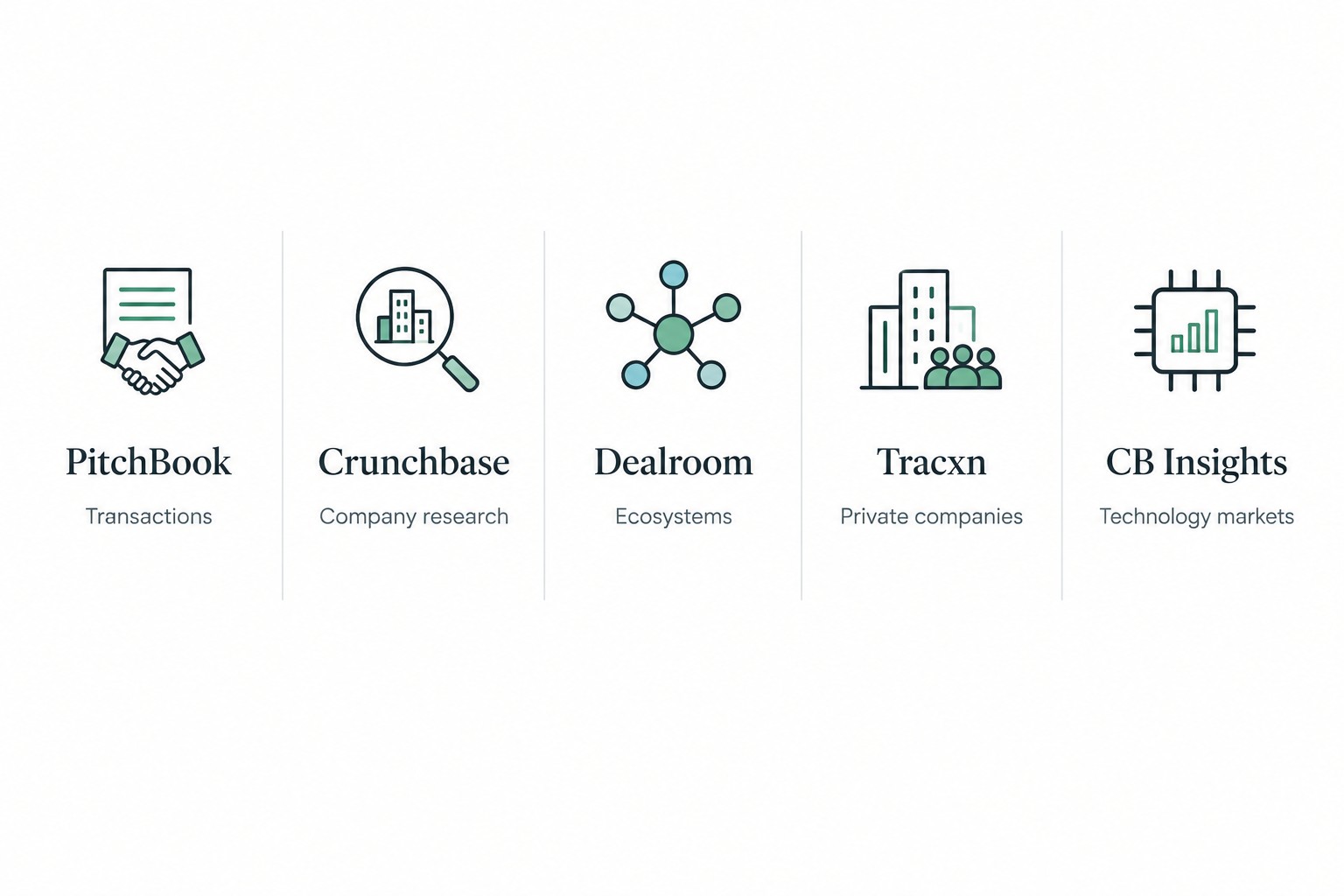
PitchBook, Crunchbase, Dealroom, Tracxn, and CB Insights are established private market intelligence platforms that venture capital firms can evaluate for investment research.
However, they serve different research requirements.
PitchBook provides private market company, financing, valuation, and transaction intelligence. Dealroom emphasizes startup ecosystems, emerging companies, and company development. Crunchbase provides company and funding information alongside market signals and predictive intelligence.
Tracxn offers structured private company research, while CB Insights focuses on technology markets, competitive intelligence, company information, and research.
None should automatically be treated as the definitive source for every claim about a private company.
For material diligence questions, investors may still need company-provided records, regulatory filings, customer evidence, financial statements, legal documentation, or independent specialist research.
The appropriate data service depends on what the investment team is trying to establish.
Five Venture Capital Data Providers Compared
The following comparison focuses on the information each platform is positioned to provide and the diligence questions it can help answer.
| Data Provider | Relevant Research Capabilities | Useful Diligence Application | Important Limitation |
|---|---|---|---|
| PitchBook | Funding history, investors, valuations, transactions, comparable companies | Financing research, market comparisons, investor histories | Private transaction details may require primary-document verification |
| Crunchbase | Company profiles, funding activity, investors, leadership, market signals | Company background, financing research, competitor discovery | Reported information, estimates, and predictions must be distinguished |
| Dealroom | Startup ecosystems, company growth, financing, founder and technology data | Market mapping, startup research, ecosystem intelligence | Coverage and reporting depth can vary across markets |
| Tracxn | Private company profiles, funding data, sectors, competitors, financial information | Company research, industry comparisons, emerging market analysis | Available detail depends on company, geography, and source |
| CB Insights | Company intelligence, technology markets, funding activity, competitive research | Market diligence, competitor analysis, technology landscape research | Market intelligence does not replace company-level financial verification |
This comparison reflects publicly documented capabilities as of November 2026. It is not an independent accuracy ranking. Specific datasets, access rights, and commercial terms should be verified with each provider.
1. PitchBook: Private Capital Transactions and Company Intelligence
PitchBook provides data and research covering private and public companies, investors, funds, financing transactions, and capital markets.
Its platform is relevant for venture capital firms investigating a company's financing history, investors, previous valuations, and comparable transactions.
PitchBook's due diligence data offering includes company profiles, transaction histories, investor information, and market comparisons.
Where PitchBook fits
Consider a growth-stage investor evaluating a company raising a new financing round.
The investment team may want to investigate the company's previous capital raises, identify comparable financings, and understand the involvement of existing investors.
PitchBook can provide a starting point for that research.
Its data can also help investors establish market context around valuations and transaction activity.
What to verify
The availability of a funding figure does not establish that every reported transaction detail is accurate or complete.
Investors should distinguish announced funding, reported transaction values, and information confirmed through company records.
A database record should not replace examination of the company's current capitalization table, executed financing documents, or other material transaction evidence.
PitchBook also publishes information about its data collection and research process, which firms can use when assessing how information enters the platform.
2. Crunchbase: Company Research and Funding Intelligence
Crunchbase provides company profiles, funding information, investor relationships, leadership details, and market activity.
Its platform combines information from several sources, including company and investor contributions, public information, automated collection systems, and analyst review.
Crunchbase also provides predictive signals intended to help users identify potential company developments.
According to its data methodology, the company combines multiple information sources and applies automated and human validation processes.
Where Crunchbase fits
Crunchbase may be useful during initial company research and market mapping.
For example, an associate evaluating a newly discovered enterprise software startup may want to identify its founders, previous financing activity, known investors, and potential competitors.
That information can help establish the questions requiring deeper investigation.
What to verify
Crunchbase offers both reported information and predictive or estimated information.
These categories should not be treated as equivalent.
For example, an estimated valuation is not the same as a valuation established through executed transaction documents.
Similarly, a predicted financing event is not confirmation that a company is raising capital.
Investment teams should identify which data fields represent reported facts, estimates, or model-generated predictions.
3. Dealroom: Startup Ecosystems and Emerging Company Intelligence
Dealroom provides intelligence on startups, technology companies, investors, founders, and innovation ecosystems.
Its information is collected through a combination of public sources, company and investor contributions, partnerships, data engineering, and analyst verification.
Dealroom's data collection methodology describes information gathered from company filings, public records, news, job boards, websites, and ecosystem partners.
Where Dealroom fits
Dealroom is relevant for firms conducting market mapping or evaluating companies within particular technology ecosystems.
For example, a venture capital firm expanding its investment coverage into European climate technology may want to understand relevant companies, financing activity, and market developments.
Dealroom can help organize that research.
Its ecosystem relationships may also provide information that is difficult to obtain through general web searches.
What to verify
Even when a provider has strong coverage within a particular ecosystem, that does not guarantee complete information about every company.
Some businesses disclose limited financial or operating information.
Others operate through legal structures that are not immediately obvious from their public profiles.
Investors should therefore verify material company details against relevant primary sources.
4. Tracxn: Structured Private Company and Market Data
Tracxn provides private market intelligence covering companies, financing activity, technology sectors, competitors, and related information.
Its platform combines automated data collection with research and analytical processes.
According to Tracxn's company database documentation, information is gathered from sources including official filings, government agencies, company websites, technology signals, and other publicly available records.
Where Tracxn fits
Tracxn may be useful for firms researching a defined investment category.
For example, an investor evaluating a financial infrastructure company may want to identify similar companies, financing histories, and competitors operating in related markets.
Structured classifications can help narrow the research universe.
What to verify
A company profile may contain substantial information without addressing the specific diligence question an investor needs to answer.
For example, knowing a company's reported financing history does not establish whether its current revenue claims are accurate.
Firms should also evaluate data availability for the sectors and geographies that matter to their investment strategies.
5. CB Insights: Technology Markets and Competitive Intelligence
CB Insights provides information about private companies, technology markets, investment activity, competitive positioning, and emerging industry developments.
Its platform combines structured data with research and analysis.
The company's market intelligence data offering includes company funding information, market research, investor intelligence, and competitive analysis.
Where CB Insights fits
CB Insights may be particularly relevant when the investment team needs to understand a company's position within a broader technology market.
Consider a fund evaluating a startup building AI infrastructure software.
The investment team may want to investigate competitors, market developments, financing activity, and how the technology category is changing.
CB Insights can support this type of research.
What to verify
Market research and competitive intelligence can establish useful context, but they do not automatically validate a startup's internal operating claims.
A market report showing increased investment in a technology category does not establish that an individual company has strong customer demand or a defensible competitive position.
Those conclusions require additional evidence.
Why Venture Capital Data Providers Produce Different Results
Different data providers may show different information about the same company.
That does not necessarily mean one provider is unreliable.
The differences can arise from several factors.
Different Sources of Information
One platform may collect information from public company announcements.
Another may receive information from investors, government records, or ecosystem partners.
A third may use predictive models to estimate information that has not been publicly confirmed.
These methods produce different kinds of evidence.
For example, a startup may announce a financing round before all transaction details are publicly available.
A data provider could record the announcement, while another waits for additional confirmation.
Different Definitions
Private market information is not always reported consistently.
Consider the term "funding raised."
Does it include convertible notes?
Does it refer only to equity financing?
Does it include government grants?
Is it the amount announced, committed, or actually received?
Different definitions can produce different totals.
Similarly, investment stages are not always classified consistently across data providers.
A company described as seed-stage by one platform may be categorized differently by another.
These distinctions matter when investors compare companies or analyze financing activity.
Different Geographic Coverage
The quality and availability of startup information can vary across markets.
Public disclosure requirements, company reporting practices, and access to government records differ by jurisdiction.
Some ecosystems also receive more media and investor attention than others.
This creates potential gaps in commercial databases.
The OECD's March 2026 research, The OECD Start-ups Database, illustrates why combining data sources can be valuable.
The OECD developed a global dataset covering nearly 4.5 million startups founded between 2000 and 2025 by integrating commercial and public information sources.
Its methodology uses Crunchbase and Dealroom as complementary inputs alongside other data.
The research demonstrates that comparing and combining sources can improve the breadth of information available for analysis.
However, combining databases does not automatically make every individual record correct.
Different Update Schedules
A company may update its website immediately after announcing a new financing round.
A data provider may reflect the change later.
Another may have already received the information through a different source.
Therefore, a record that was accurate when collected may no longer represent the company's current position.
Data freshness is a separate question from data accuracy.
Investors should evaluate both.

What Makes a Venture Capital Data Source Trustworthy?
A trustworthy source is not simply one that contains a large amount of information.
It should provide information appropriate for the decision being made, with enough context to understand its reliability.
Five dimensions are particularly important.
1. Provenance: Where Did the Information Originate?
Every material claim should have an identifiable origin.
For example, a company's financing history might be supported by an official filing, a company announcement, an investor statement, or a commercial database entry.
These sources do not necessarily establish the same facts.
A press release may confirm that a financing was announced.
Executed transaction documents may establish the actual securities issued and the terms of the transaction.
The investment team should understand which question each source can answer.
2. Accuracy: Does the Information Match the Evidence?
A data provider might report that a company has 100 employees.
But what does that number represent?
It could be based on public professional profiles, a company disclosure, or an estimate.
The investor should not automatically interpret it as a verified payroll count.
Accuracy must be assessed relative to the meaning of the field and the evidence supporting it.
3. Freshness: When Was the Information Valid?
Some information becomes outdated quickly.
Employee counts, revenue, financing activity, leadership roles, and product development can change significantly over a few months.
A useful data service should provide enough information to understand when a record was updated or when the underlying event occurred.
4. Coverage: What Information Is Missing?
Missing information is not the same as negative information.
A database that does not list a startup's most recent financing round has not established that the round did not occur.
Likewise, the absence of reported revenue does not establish that a company has no revenue.
A reliable research process should distinguish between:
- Confirmed information
- Reported but unverified information
- Estimated information
- Missing information
- Conflicting information
This helps prevent incomplete records from becoming misleading conclusions.
5. Usability: Can the Data Be Used Within the Fund's Workflow?
Reliable information is less useful when the investment team cannot access, retrieve, or interpret it efficiently.
For example, a fund may need to connect company data with its CRM, research repository, or investment committee preparation process.
Before purchasing a data service, the firm should evaluate available integrations, APIs, data export options, usage restrictions, and licensing terms.
Access to information through a website does not automatically grant permission to redistribute the data or incorporate it into AI training or automated systems.
These conditions should be understood before implementation.
Which Sources Should VC Firms Use to Verify Important Claims?
Different diligence questions require different evidence.
An investment team should not rely on one general-purpose company database to verify every aspect of a business.
| Diligence Question | Useful Research Source | Stronger Verification Evidence |
|---|---|---|
| Does the company legally exist? | Company databases and registries | Relevant official corporate records |
| Who owns the company? | Reported ownership information | Current company records and legally reviewed capitalization documents |
| How much funding has it raised? | Funding databases and announcements | Executed financing documents and supporting company records |
| What is its revenue? | Company disclosures and data providers | Financial statements, underlying records, and appropriate independent review |
| Who are its customers? | Company materials and public references | Customer contracts, references, and supporting operating records |
| Does the company own its technology? | Public IP records and company disclosures | Assignment agreements, ownership records, and legal diligence |
| Who are its competitors? | Market intelligence platforms | Independent research and relevant market evidence |
| What is the company's market opportunity? | Market reports and industry datasets | Tested assumptions, market evidence, and customer research |
| What are its financial risks? | Financial datasets and company reports | Reviewed financial information and detailed analysis |
The strongest available evidence depends on the question.
For example, official corporate registries may help establish legal entity information.
The U.S. Securities and Exchange Commission provides access to filings through EDGAR.
For companies incorporated in the United Kingdom, investors can use the official Companies House register to investigate available company information.
However, a filing should not be treated as independently verified proof of every statement it contains.
Regulatory filings and registries provide important records, but investors still need to understand the scope and limitations of the information.
Example: Resolving Conflicting Startup Funding Data
Consider a hypothetical company preparing to raise a Series A.
The investment team collects the following information.
| Source | Reported Funding | Additional Context |
|---|---|---|
| Company pitch deck | $7 million | States total capital raised |
| Data provider A | $5 million | Lists an earlier seed financing |
| Data provider B | $6 million | Includes an additional transaction |
| Company announcement | $2 million | Describes a financing extension |
At first glance, the information appears inconsistent.
However, the figures could reflect different reporting periods or definitions.
The company may have completed its seed financing in several stages.
One database may not have recorded the extension.
Alternatively, the founder's reported total may include financing instruments that a provider categorizes differently.
What Should the Investment Team Do?
The first step is to establish whether the figures refer to the same legal entity and the same transactions.
The team should then identify the sources and dates associated with each figure.
Next, it should request or examine appropriate primary evidence for material financing claims.
That may include executed financing documents, approved capitalization records, and other transaction information.
The investment team should also clarify whether any reported amounts represent announced commitments rather than completed financing.
Only after those questions are resolved should the relevant figure be accepted into the fund's research record.
What AI Can Contribute
An AI-assisted research workflow could identify the conflicting figures, retrieve available supporting information, and prepare a reconciliation checklist.
For example:
Finding: Three different total funding amounts have been reported.
Sources: Pitch deck, two private market databases, and a company announcement.
Potential explanation: Different reporting dates or financing definitions.
Verification required: Confirm completed transactions and applicable financing instruments.
Status: Unresolved pending review.
This is a useful output because it preserves uncertainty.
The AI system should not independently choose the highest figure or average the reported amounts.
A reliable due diligence process does not eliminate uncertainty by inventing certainty. It identifies what still needs to be established.
How to Evaluate Data Providers Before Purchasing
A vendor's demonstration may show detailed profiles for well-known companies.
That does not necessarily demonstrate how useful the platform will be for a firm's actual investment strategy.
A stronger evaluation uses a representative sample of companies the fund has already investigated.
Step 1: Build a Representative Test Set
Select approximately 20 companies across the firm's target sectors, geographies, and investment stages.
Include companies with different levels of public visibility.
For example:
- Well-documented venture-backed companies
- Recently funded startups
- Emerging companies with limited public information
- Companies that have changed names
- Businesses with complex corporate structures
- Companies operating in less-covered markets
The sample should reflect the companies the investment team actually researches.
Step 2: Establish Reference Information
For each company, identify the information already supported by reliable records.
This might include known financing transactions, founder identities, company status, or relevant operating milestones.
The team should distinguish verified information from assumptions in its own database.
Otherwise, the evaluation may simply measure how closely a vendor matches existing inaccuracies.
Step 3: Test Coverage and Accuracy Separately
Two questions should be evaluated independently.
Coverage: Does the provider have the requested information?
Accuracy: When the provider supplies information, is it consistent with reliable evidence?
A platform that omits a field should not be evaluated in exactly the same way as one that confidently reports an incorrect value.
Step 4: Measure Freshness
Check whether the provider reflects material developments that occurred recently.
For example, a company may have completed a financing round or changed its leadership team.
Determine whether the relevant records have been updated.
Step 5: Evaluate Source Transparency
Ask whether users can identify where material information originated.
A platform that provides a funding number without supporting context may be less suitable for certain diligence tasks than one that helps investors investigate the underlying evidence.
Step 6: Test Workflow Integration
Determine whether the firm can retrieve approved information through its normal research process.
This may involve CRM integrations, APIs, permitted exports, or other supported methods.
Also evaluate whether contractual terms allow the intended use.
A Practical Vendor Evaluation Scorecard
The following framework is an illustrative starting point for comparing providers.
| Evaluation Category | Suggested Weight |
|---|---|
| Accuracy against verified reference information | 25% |
| Coverage of target companies and required fields | 20% |
| Source transparency and provenance | 20% |
| Data freshness | 15% |
| Integration and workflow compatibility | 10% |
| Licensing, security, and total cost | 10% |
| Total | 100% |
The weights should be adjusted to the fund's actual requirements.
A pre-seed investor may place greater emphasis on emerging company coverage.
A growth-stage investor may care more about financing history, valuations, and transaction data.
The scorecard should also include minimum requirements that cannot be compensated for by strong performance elsewhere.
For example, if a provider's license does not permit the firm's intended data use, a high score on other criteria may not make it an appropriate choice.
The objective is not to produce a universal vendor ranking.
It's to identify which information service works reliably for the firm's actual diligence needs.
Can AI Combine Multiple Data Providers Into One Due Diligence Workflow?
Yes, where access rights and technical capabilities permit.
AI systems can help investment teams retrieve, organize, and compare information from multiple approved sources.
However, combining information does not automatically establish its accuracy.
Consider a workflow that retrieves funding information from two private market databases.
If the figures conflict, the system should preserve both values and identify the relevant sources.
It should not silently combine them into one record.
What a Reliable AI Research Workflow Needs
A fund-specific workflow could include five stages.
| Stage | Activity | Expected Output |
|---|---|---|
| 1. Retrieve | Collect information from approved sources | Source-linked records |
| 2. Normalize | Match companies and organize fields | Consistent company identity and field definitions |
| 3. Compare | Identify agreements, omissions, and conflicts | Data discrepancy register |
| 4. Verify | Request or retrieve stronger supporting evidence | Reviewable evidence |
| 5. Prepare | Assemble an investment research brief | Draft with sources and unresolved questions |
Why Source-Backed Research Matters
AI-generated research can appear convincing even when its claims are not fully supported.
Research published by NIST on evaluating machine-generated reports emphasizes that accurate and verifiable reports require evaluating whether claims are supported by their source documents.
For venture capital firms, this is particularly important when AI-generated findings are incorporated into investment committee materials.
A citation is useful only when the referenced information actually supports the claim.
Our article on evidence checks for AI-assisted due diligence examines how investment teams can review those claims before investment committee discussions.
The same principle applies to commercial data providers.
A database entry should be treated as evidence with a defined source and scope, not as a universal statement of truth.
The Difference Between Data Services and Due Diligence Software
Venture capital firms sometimes evaluate data platforms and diligence workflow software as though they perform the same function.
They do not.
Data services provide information. Due diligence software helps investment teams work through the evaluation process.
A data service may provide company profiles, funding histories, or competitive intelligence.
A diligence workflow system may organize research questions, documents, findings, exceptions, and investment committee materials.
A firm may need both.
For example, an investment team might retrieve company information from a private market database and combine it with founder-provided documents and internal research.
The due diligence workflow then helps the team determine which information has been reviewed, which assumptions remain uncertain, and what must be resolved before a decision.
This distinction matters because purchasing another data subscription does not necessarily solve problems involving fragmented research or inconsistent investment processes.
Our article on AI-assisted financial insights for PE and VC teams examines the separate analytical work required when investment teams need to investigate financial performance and assumptions.
How Much Should VC Firms Spend on Due Diligence Data?
There is no universal budget.
The cost depends on the number of users, required datasets, permitted access methods, integration needs, and commercial agreements.
A smaller seed-stage fund may have different requirements from a multi-fund manager conducting complex growth-stage diligence.
When evaluating providers, firms should look beyond the subscription price.
Important cost considerations include:
Data access: Which company records and research fields are included?
User access: How many investment professionals need access?
API and integration rights: Can the data be used within the firm's existing systems?
Usage limits: Are there restrictions on queries, exports, or programmatic access?
Data licensing: Can information be retained, processed, or used within AI-assisted workflows?
Maintenance: Who manages integrations and resolves problems when records or APIs change?
Verification costs: How much additional research is required to confirm material information?
The lowest subscription cost does not necessarily produce the lowest total research cost.
Likewise, an expensive database may not be worthwhile if it doesn't provide reliable coverage of the companies the fund actually evaluates.
The appropriate purchasing decision should be based on demonstrated usefulness during a representative evaluation.
How Sonexa Labs Approaches Due Diligence Data and Investment Research
Sonexa Labs develops fund-specific AI models and agents around venture capital firms' investment strategies, approved data, and internal research processes.
Its approach differs from purchasing a standardized private company database.
Sonexa is not positioned as a replacement for PitchBook, Crunchbase, Dealroom, Tracxn, or CB Insights.
Instead, it develops commissioned systems that can help investment teams work with information within their own defined workflows.
Research Built Around the Fund's Questions
Through Screening & Investment Research, Sonexa can scope AI systems around a firm's investment criteria, evidence requirements, and research process.
For example, a fund may want to compare approved company information against its screening rubric.
Another may want a structured research brief that distinguishes company claims, independently supported findings, and unresolved questions.
These workflows depend on the firm's available information, approved sources, and agreed project scope.
Supporting Due Diligence and Investment Committee Preparation
Sonexa's Due Diligence & IC Preparation offering addresses fund-specific systems that organize research and prepare reviewable investment materials.
For example, a commissioned workflow could help organize approved research, identify missing evidence, and prepare a draft investment committee brief.
The system would need to preserve source references and distinguish unresolved questions from verified findings.
Investment professionals would remain responsible for reviewing the analysis and making decisions.
Connecting Research With Institutional Knowledge
A firm's existing research can also be a valuable source of information.
Previous investment memos, founder discussions, diligence records, and screening decisions may contain context unavailable through commercial databases.
Sonexa's Institutional Knowledge & Firm Operations offering addresses the development of systems that make approved internal information easier to retrieve.
A fund could commission a workflow that retrieves previous research alongside newly available company information.
However, access to third-party databases or private company records would remain subject to the relevant permissions, licenses, and implementation arrangements.
Why the Fund's Process Matters
Different investment firms require different types of evidence.
A seed-stage software fund may prioritize founder backgrounds, customer traction, and market developments.
A growth-stage investor may require more detailed financial information and transaction analysis.
A specialist healthcare fund may need technical and regulatory evidence that general private market databases cannot provide.
Sonexa's Tailored Solutions approach is designed around those differences.
The objective is to support a fund's research process using appropriate models, data, and review controls rather than assuming one standardized workflow fits every investment team.
Conclusion: Trustworthy Diligence Starts With Verifiable Information
Private market data services can make venture capital research more efficient.
PitchBook, Crunchbase, Dealroom, Tracxn, and CB Insights provide different combinations of company intelligence, financing information, market research, and investment data.
But no single provider should automatically be treated as the definitive authority for every diligence question.
The strongest research process combines relevant data services with appropriate primary evidence, clear source definitions, and a consistent method for handling conflicting information.
AI can help organize that process.
It can retrieve information, identify discrepancies, prepare research, and highlight questions requiring further investigation.
But it should not turn uncertain information into confident conclusions.
For venture capital firms, the objective is not simply to collect more data.
It's to establish which information can be relied upon, what remains unknown, and what evidence is needed before an investment decision.
Sonexa Labs develops fund-specific AI models and agents around venture capital screening, research, due diligence, and institutional knowledge workflows.
Book a Demo to explore how Sonexa can support your firm's investment research process.
Frequently Asked Questions
Which data providers are useful for venture capital due diligence?
PitchBook, Crunchbase, Dealroom, Tracxn, and CB Insights provide different forms of private market information relevant to venture capital research. Their suitability depends on the firm's target companies, required data, geographic coverage, and diligence questions.
What are trusted venture capital data services for due diligence workflows?
Trusted data services provide relevant company and market information with sufficient accuracy, freshness, provenance, and coverage for the intended research task. Firms should test providers using verified reference information rather than relying solely on vendor claims.
Is PitchBook or Crunchbase more reliable for VC due diligence?
Neither can be declared universally more reliable without testing the specific information required. PitchBook emphasizes private capital transactions and investment intelligence, while Crunchbase provides company and funding data alongside market signals. Accuracy and coverage should be assessed against the firm's actual diligence needs.
Can venture capital firms rely on one data provider?
A single provider may be sufficient for some initial research tasks. However, material investment claims may require additional sources, company documentation, regulatory records, or independent verification.
How do VC firms verify startup funding information?
Investors can compare database records, company announcements, and relevant public filings, then examine appropriate primary transaction evidence. Material financing claims may require executed financing documents, capitalization records, and other supporting information.
Why do private market databases show different funding amounts?
Differences may result from reporting dates, financing definitions, incomplete records, legal entity structures, or the sources used by each platform. Investors should investigate the discrepancy rather than automatically select one value.
Can AI verify private company data?
AI can assist by retrieving sources, matching records, identifying discrepancies, and organizing supporting evidence. However, AI-generated conclusions still require appropriate verification, particularly for material financial and legal claims.
What should VC firms look for in a due diligence data service?
Important criteria include accuracy, coverage, source transparency, data freshness, integration capabilities, licensing terms, security requirements, and total operating cost.
Is company data from regulatory filings always accurate?
No. Regulatory filings can provide important primary records, but their evidentiary value depends on the filing type, reporting obligations, and information disclosed. Investors should understand what each filing establishes and whether additional verification is necessary.
What is the difference between due diligence data and due diligence software?
Due diligence data services provide information about companies, investors, transactions, and markets. Due diligence software helps investment teams organize research, track evidence, manage review processes, and prepare investment materials.
How does Sonexa Labs support venture capital due diligence?
Sonexa develops commissioned AI models and agents around individual venture capital firms' investment workflows. Depending on the agreed scope, these systems may help organize approved data, identify missing evidence, prepare research materials, and retrieve institutional knowledge.