AI-First VC Operations Stack: Systems That Connect
A venture capital firm uses one platform to discover startups, another to track founder relationships, a separate database for investment research, and spreadsheets to monitor its portfolio.
Meeting notes are stored somewhere else. Investment memos sit in shared folders. The finance team has its own systems for fund reporting.
Then the firm starts adopting AI.
An associate uses ChatGPT to research companies. A partner introduces an AI meeting notetaker. Someone connects an automation tool to the CRM. The operations team experiments with generating quarterly portfolio summaries.
Each tool solves a particular problem.
But the underlying investment process is still fragmented.
The same company information gets entered into multiple applications. Previous research isn't consistently available during new evaluations. AI-generated summaries reference information that may no longer be current.
The firm has adopted AI, but it hasn't fundamentally improved how information moves through its operations.
This is the difference between using AI tools and building an AI-first operating environment.
An AI-first operations stack for a VC firm connects existing investment systems with fund-specific data, defined workflows, and AI-assisted processes that can be reviewed and controlled by the investment team.
It doesn't necessarily require replacing every application the fund already uses.
In many cases, the more practical approach is to preserve reliable systems of record and introduce AI where information needs to be collected, analyzed, organized, or transferred between workflows.
This article examines what an AI-first venture capital operations stack actually needs, how its components should work together, and where investment firms should begin.
What Is an AI-First Operations Stack for a VC Firm?
An AI-first venture capital operations stack is a collection of software, data systems, and AI-enabled workflows designed to support the activities involved in operating a venture capital firm.
These activities can include deal discovery, relationship management, investment screening, diligence, portfolio monitoring, fund operations, and LP reporting.
Traditional venture capital software generally focuses on individual functions.
A CRM maintains relationships and investment opportunities.
A portfolio management platform organizes company performance information.
A fund accounting system maintains financial records.
An AI-first approach considers how information can move between these systems and how repeatable work can be supported through AI.
However, AI-first does not mean AI makes the investment decisions.
It means that when a task can be supported by reliable data, defined rules, and appropriate automation, the firm evaluates whether AI can reduce manual work without compromising accuracy or accountability.
For example, an investment team may want to generate an initial research brief whenever a relevant company enters its pipeline.
Rather than manually collecting the same information each time, an AI workflow could retrieve approved sources, organize the findings, identify missing evidence, and prepare a draft.
The associate would then review the information before deciding whether the company deserves further attention.
The investment decision remains with the investor.
The repetitive preparation becomes more structured.
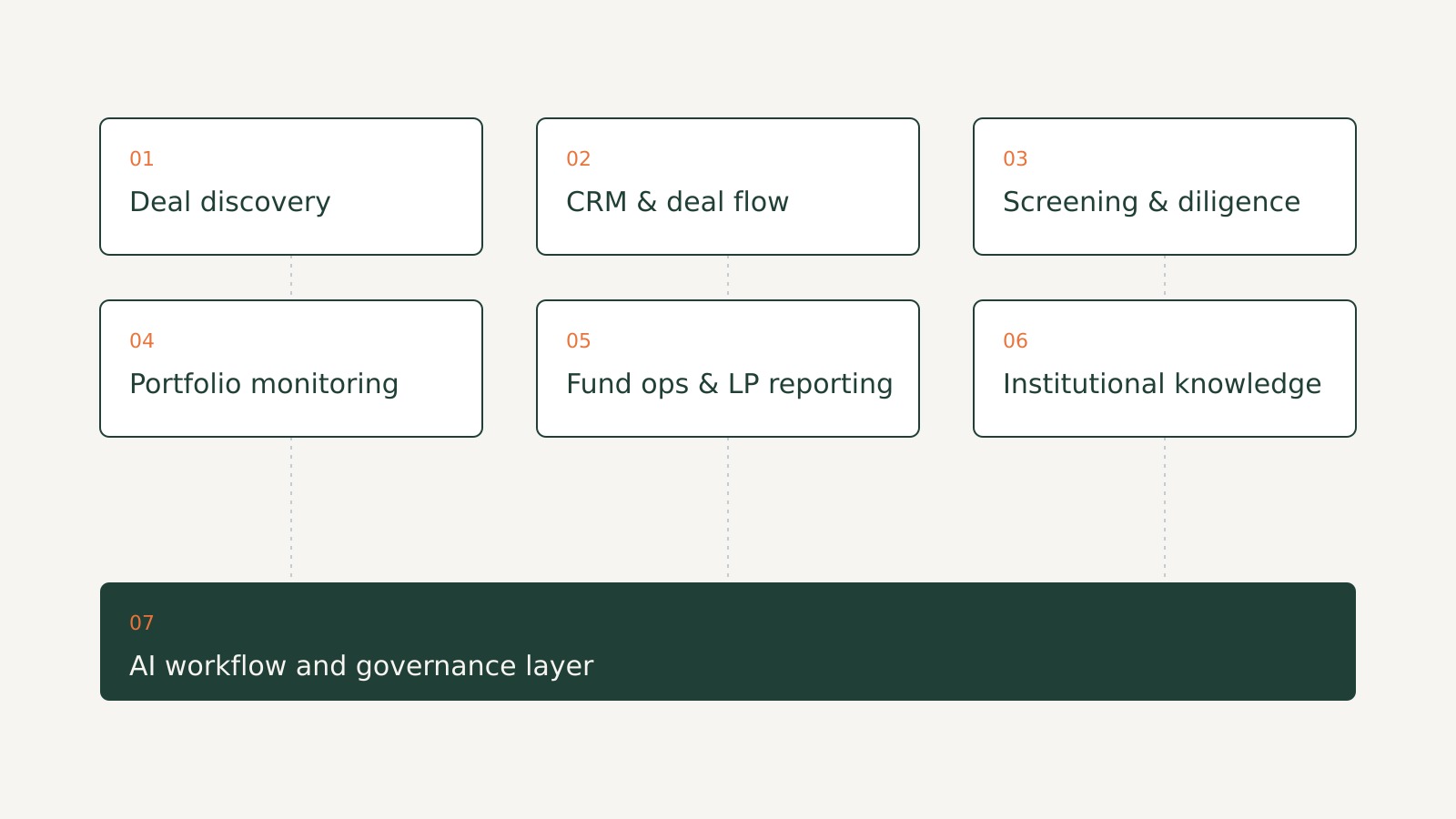
The Seven Components of an AI-First VC Operations Stack
Most venture capital firms don't need seven completely separate software platforms.
They do, however, need to consider seven functional components when designing their operating environment.
| Component | Primary Responsibility | Where AI Can Help |
|---|---|---|
| Deal discovery | Identify relevant startups and founders | Company research, signal monitoring, opportunity identification |
| CRM and deal management | Maintain relationships and investment pipelines | Meeting summaries, record updates, follow-up coordination |
| Screening and diligence | Evaluate potential investments | Research preparation, document analysis, evidence organization |
| Portfolio intelligence | Monitor existing investments | KPI extraction, company updates, exception detection |
| Fund operations and LP reporting | Maintain financial and investor reporting processes | Document preparation, reporting checks, draft commentary |
| Institutional knowledge | Preserve previous research and investment decisions | Search, retrieval, historical comparisons |
| AI workflow and governance layer | Connect approved data and coordinate defined tasks | Agent execution, permissions, validation, and review workflows |
The first five components primarily address operational functions.
The sixth preserves information across those functions.
The seventh determines how AI can interact with the rest of the environment.
That connecting layer is what distinguishes a collection of AI tools from an AI-first operating stack.
1. Deal Discovery and Market Intelligence
Venture capital investment processes begin with finding relevant opportunities.
For early-stage firms, this often involves monitoring emerging companies, identifying founders, researching markets, and building relationships before a formal fundraising process begins.
Traditional sourcing methods include professional networks, events, referrals, and inbound founder submissions.
AI-assisted discovery can expand these methods by helping investors monitor relevant company and founder activity.
Depending on the available data, useful signals may include company formation, product launches, hiring activity, technical development, and other early indicators of company building.
But identifying a signal is not the same as identifying a suitable investment.
A new company registration may be relevant to one fund and completely irrelevant to another.
The value depends on whether the information aligns with the firm's investment strategy.
What This Component Needs
A useful discovery process should capture the company's identity, relevant evidence, source information, and reasons it may fit the fund's investment mandate.
It should also allow investors to distinguish companies they are actively researching from those they simply want to monitor.
For example, an enterprise software fund may want to identify emerging companies in a particular infrastructure category.
The fund should be able to review why a company appeared and determine whether it warrants further investigation.
Juno by Sonexa Labs is a standalone product designed around early-company discovery, tracking, enrichment, and sourcing follow-through.
Its role is to help investment teams identify and investigate emerging opportunities.
However, a discovery platform should not automatically be treated as the firm's complete investment management system.
Once a company becomes an active opportunity, the investment team needs a reliable process for managing the relationship and subsequent evaluation.
2. CRM and Deal Flow Management
A venture capital CRM maintains the relationships, company records, and investment opportunities known to the firm.
Platforms such as Affinity, DealCloud, and Attio support different approaches to managing this information.
The CRM is often the most practical system of record for the investment pipeline.
It may contain:
- Company and founder records
- Relationship history
- Opportunity ownership
- Investment stages
- Meeting activity
- Next actions
- Previous investment decisions
The challenge is keeping those records accurate and useful.
An investment professional may complete several founder meetings in a week without updating every relevant field.
Another team member may conduct additional research that never makes it into the company's CRM record.
Over time, the CRM can become an incomplete representation of the investment process.
Where AI Fits
AI can assist with preparing meeting summaries, identifying missing information, suggesting record updates, and organizing follow-up actions.
For example, after a founder meeting, an AI-assisted process could prepare a summary of important developments and identify agreed next steps.
The investment team could approve the relevant information before it is added to the CRM.
This reduces repetitive data entry while maintaining control over what becomes part of the firm's official records.
Our comparison of CRM platforms for venture capital deal flow tracking examines the differences between relationship-oriented and configurable investment CRMs.
The important consideration for an AI-first stack is whether the CRM can exchange relevant information with the firm's other approved systems.
3. Investment Screening, Research, and Due Diligence
Investment research is one of the most information-intensive activities within a venture capital firm.
An associate may need to review a pitch deck, research the market, investigate competitors, evaluate financial information, and prepare an initial recommendation.
When an opportunity progresses into diligence, the information requirements become more extensive.
AI can help organize and prepare this information.
However, the system needs to understand the firm's investment criteria rather than apply a universal definition of an attractive startup.
Research published by the National Bureau of Economic Research on venture capital decision-making surveyed 885 institutional venture capitalists across 681 firms.
The study examined sourcing, investment selection, valuation, post-investment activities, and other aspects of venture capital operations.
Respondents considered investment selection particularly important to value creation.
That finding reinforces why the research process matters.
Processing more pitch decks isn't automatically valuable if the investment team cannot evaluate opportunities effectively.
What an AI Research Workflow Needs
A useful system should distinguish between company-provided information, independently supported findings, and assumptions requiring investigation.
For example, an AI-assisted screening workflow could organize:
- Founder and company background
- Market information
- Business model
- Product differentiation
- Competitive landscape
- Financial information
- Investment thesis alignment
- Identified risks
- Outstanding questions
The output should include references to the underlying information wherever practical.
A structured VC screening rubric can help establish the evaluation criteria the system should use.
For firms with more specialized requirements, Sonexa's Screening & Investment Research offering addresses commissioned AI workflows developed around fund-specific research standards.
The objective is to prepare reviewable information, not automatically determine which companies deserve investment.
4. Portfolio Monitoring and Intelligence
Once an investment is made, the firm's operational responsibilities change.
Instead of evaluating whether to invest, the team needs to understand how the portfolio company is performing.
This can involve collecting financial information, monitoring operating metrics, reviewing company developments, and maintaining investment records.
Portfolio management platforms help organize these activities.
However, gathering information from portfolio companies can still involve considerable manual work.
Some companies submit structured financial reports.
Others share spreadsheets, board presentations, or written updates.
The information may be inconsistent across reporting periods.
Where AI Fits
AI can assist by extracting information from approved company updates and organizing it into structured records.
For example, a portfolio monitoring workflow might identify reported revenue, cash balances, burn rates, financing activity, and operating milestones.
It could also flag missing information or significant changes between reporting periods.
But the system needs to preserve context.
A SaaS company reporting annual recurring revenue is not directly comparable to a biotechnology company reporting clinical development milestones.
Even within the same industry, metric definitions may differ.
An AI-first stack should preserve those distinctions instead of forcing every company into a single scoring model.
The firm should also identify which portfolio system maintains the approved metrics and which AI applications are permitted to read or prepare information from them.
Sonexa's Portfolio Intelligence offering addresses this category through potential fund-specific AI engagements.
The goal is to make portfolio information more useful to the investment team while preserving appropriate review procedures.
5. Fund Operations and LP Reporting
Fund operations involve a different set of responsibilities from investment sourcing and research.
Finance and operations teams may manage capital calls, distributions, financial reporting, investor records, valuations, and LP communications.
These activities require accurate financial information and clearly defined responsibilities.
An AI system should not replace the accounting records or calculations maintained by the fund's responsible finance professionals and service providers.
Instead, it can support selected activities surrounding those records.
For example, AI may assist with preparing quarterly portfolio commentary, organizing approved investor reporting materials, identifying missing information, and retrieving historical reporting context.
Reporting Standards Still Matter
The Institutional Limited Partners Association's reporting standards provide frameworks intended to improve consistency and transparency in private capital reporting.
The updated reporting and performance templates released in 2025 are relevant to fund reporting requirements beginning in 2026, subject to their respective implementation scopes.
An AI-enabled reporting process should work within the fund's applicable accounting, contractual, and reporting requirements.
For example, a system could help identify whether required sections of an investor reporting package are complete.
However, the financial information must still originate from authoritative records and receive appropriate approval.
Our article on AI for LP reporting examines these automation opportunities in more detail.
Within an AI-first operations stack, the important distinction is between preparing reporting materials and maintaining the official financial records.
6. Institutional Knowledge and Investment History
One of the most valuable resources within a venture capital firm is the information it accumulates over time.
This includes previous investment research, founder meetings, market observations, diligence findings, investment memos, and decisions.
However, much of that information remains distributed across individual applications and team members.
An investment professional may remember reviewing a company two years earlier but struggle to locate the original research.
A new associate may investigate a market without knowing that the firm previously conducted extensive work in the same category.
A partner may want to revisit an investment decision but lack access to the reasoning behind it.
An AI-first stack should address this problem.
Making Historical Information Retrievable
A permission-aware knowledge system could help authorized users retrieve previous research, meeting context, and investment decisions from approved sources.
For example, an investment team might ask:
"What were our main concerns when we reviewed this company last year?"
A useful system should retrieve the historical information and identify its source.
It should also distinguish the firm's previous assessment from the company's current circumstances.
This distinction is essential.
An investment decision made in 2024 may no longer reflect the company's position in 2026.
The objective is not to treat historical opinions as permanent facts.
It is to preserve institutional context so investors can make more informed current assessments.
Sonexa's Institutional Knowledge & Firm Operations offering focuses on this potential application of fund-specific AI systems.
This capability can become particularly valuable when investment professionals change roles or when the firm revisits companies after extended periods.
7. The AI Workflow and Governance Layer
This is the component that connects the rest of the stack.
A venture capital firm may already have reliable sourcing, CRM, portfolio monitoring, and fund accounting tools.
The opportunity may not be to replace those systems.
Instead, the firm may need a controlled way to retrieve information from them, perform defined tasks, and return reviewable outputs.
An AI workflow layer can potentially coordinate these activities.
For example, when a company progresses into deeper research, a workflow might retrieve relevant approved information, prepare a draft research brief, identify missing evidence, and notify the responsible investment professional.
However, that process requires more than a connection between software applications.
It needs clear rules about which information can be accessed, which tasks can be executed, and which actions require approval.
What the Connecting Layer Should Include
An effective implementation should define:
Approved data access: Which systems and documents AI can retrieve information from.
Source identification: Where important facts, metrics, and statements originated.
Permission controls: Which users and processes can access particular information.
Workflow rules: What triggers an automated task and what outcome is expected.
Human approval: Which outputs or actions require review before they are accepted.
Auditability: How users can understand what information was used and what actions occurred.
Error handling: What happens when information is missing, inconsistent, or unavailable.
These requirements become more important as AI systems begin coordinating activities across multiple applications.
The NIST Generative AI Risk Management Profile provides a broader framework for evaluating AI governance, reliability, and associated risks.
For venture capital firms, these considerations should be incorporated into workflow design rather than addressed only after implementation.
How the Components Should Work Together
The value of an AI-first stack becomes clearer when examining a complete investment workflow.
Consider a hypothetical seed-stage VC firm focused on enterprise software.
The firm wants to identify promising companies earlier, maintain consistent screening, and preserve research for future investment decisions.
A connected workflow could operate as follows.
| Stage | System or Function | AI-Assisted Activity | Required Review |
|---|---|---|---|
| 1. Discover | Company discovery platform | Identify and organize relevant emerging companies | Investor confirms relevance |
| 2. Record | Investment CRM | Prepare or update company information | Team validates records |
| 3. Screen | Investment research workflow | Apply documented screening criteria and identify gaps | Associate reviews findings |
| 4. Investigate | Research and diligence systems | Organize evidence and prepare draft analysis | Investment team validates research |
| 5. Decide | Investment committee workflow | Assemble review materials and outstanding questions | Partners make decisions |
| 6. Monitor | Portfolio management system | Organize approved portfolio updates | Investment and finance teams review |
| 7. Report | Fund reporting environment | Prepare reporting materials from approved sources | Authorized team approves distribution |
The systems do not necessarily need to be connected through a single vendor.
The important consideration is whether information can be exchanged reliably and whether the firm retains control over the process.
A Practical Example
Suppose a new company is discovered through an early-stage sourcing platform.
The investment team determines that the company deserves an initial review.
The company is added to the firm's CRM, where the opportunity is assigned to an associate.
An AI-assisted screening workflow retrieves approved information and prepares an initial research summary.
The associate reviews that summary, identifies two unanswered questions, and schedules a founder meeting.
After the meeting, relevant notes are reviewed and added to the company's record.
The opportunity is then brought to a partner discussion.
If the firm decides to pass, the decision and its supporting reasoning are preserved.
Six months later, the company announces a significant commercial milestone.
The investment team can retrieve the historical evaluation and determine whether the new information changes its assessment.
The most valuable part of this example isn't any individual AI task.
It's that information and reasoning remain connected as the opportunity moves through the firm's investment process.
This is what an AI-first operating environment should aim to support.

Why an AI-First Stack Needs Clear Systems of Record
A common mistake in AI implementation is allowing multiple applications to maintain conflicting versions of the same information.
Consider a company whose revenue appears in three places:
- The investment CRM contains a founder-reported estimate.
- A research document contains an earlier figure.
- The portfolio management system contains a reviewed financial update.
If an AI agent retrieves information from all three sources, which number should it use?
Without a clear answer, automation can make existing data problems worse.
The solution begins with defining which systems are authoritative for different types of information.
| Information Type | Potential System of Record | AI's Appropriate Role |
|---|---|---|
| Founder relationships | CRM | Retrieve history and suggest updates |
| Investment pipeline status | CRM or investment workflow platform | Identify missing actions and prepare summaries |
| Research findings | Approved research repository | Organize evidence and retrieve sources |
| Investment decisions | Approved investment records | Retrieve historical reasoning |
| Portfolio company metrics | Portfolio monitoring system | Extract updates and flag discrepancies |
| Fund accounting figures | Accounting system or administrator | Retrieve approved financial information |
| LP reporting materials | Approved reporting repository | Prepare drafts and support checks |
These assignments are illustrative.
Each firm needs to identify its own authoritative systems based on existing processes.
The objective is not to centralize every piece of information in one database.
It is to ensure that information can be retrieved and used without losing its source, meaning, or approval status.
Company Identity Also Matters
The same company may appear under different names across systems.
A CRM may use a trading name, while an accounting platform uses the legal entity name.
A sourcing platform may identify a parent company, while internal records refer to a subsidiary.
Without consistent company identifiers and record-matching rules, AI workflows can associate information with the wrong entity.
A useful operating architecture should therefore define how company identities are matched, how duplicates are handled, and which record becomes authoritative.
These foundational details may appear less exciting than AI agents.
But they determine whether the resulting automation can be trusted.
Should Venture Capital Firms Replace Their Existing Software?
Usually, the first step should be evaluating the tools the firm already uses.
Replacing a functioning CRM, portfolio management platform, or fund accounting system can introduce migration costs and operational disruption.
If those tools already maintain reliable records, an AI-first architecture may be able to build around them.
However, some systems may lack the integration capabilities or data quality required for useful automation.
The decision should be based on the actual workflow.
When Existing Software Is Enough
A firm may not need additional custom infrastructure when its requirements involve standard functions such as contact management, basic deal tracking, investor portals, or recurring financial reporting.
Existing software may already provide the necessary capabilities.
The firm should first determine whether those capabilities are being used effectively.
When Additional Automation Makes Sense
A separate AI workflow may be useful when information repeatedly moves between systems or requires manual preparation.
For example, a fund may want to combine approved research documents, CRM records, and historical screening decisions into one reviewable investment brief.
That workflow may require more than the native features of any individual platform.
When Custom AI Becomes Relevant
A tailored system may be worth evaluating when the firm's requirements depend on its investment thesis, internal research methodology, permission structure, or historical knowledge.
This is especially relevant when the workflow occurs frequently enough to justify the cost of development and maintenance.
However, custom software should not be the default response to every operational problem.
The firm should compare the proposed implementation against existing software, simpler integrations, and process improvements.
Where Should a VC Firm Start?
A firm doesn't need to automate its entire investment lifecycle at once.
A more practical approach is to establish the existing process, identify one meaningful bottleneck, and test whether AI improves it.
Step 1: Map the Current Workflow
Start by documenting how information moves through the firm.
For example:
How does a company enter the pipeline?
Who reviews it?
Where is the research stored?
How are decisions documented?
What happens to companies that are passed on?
Which records are used for portfolio monitoring and LP reporting?
The answers reveal where information is duplicated, lost, or repeatedly recreated.
Step 2: Identify the Systems of Record
Determine which applications maintain authoritative information.
This includes company records, investment decisions, portfolio metrics, and financial information.
A firm should also identify which data sources can be used by AI and what access restrictions apply.
Step 3: Select One Repeatable Workflow
Choose a task that occurs regularly and has clear inputs and expected outputs.
For example, a fund might begin by automating first-pass research preparation.
Another might prioritize consolidating portfolio company updates.
The starting point should reflect the firm's operational needs rather than the capabilities of a particular AI tool.
Step 4: Define What Success Looks Like
Before building or buying anything, establish how the workflow will be evaluated.
Possible measurements include preparation time, data completeness, research accuracy, correction rates, and the time required for human review.
The objective should be an improvement in the complete process.
Generating an AI summary quickly is not useful if the investment team spends more time correcting it than it previously spent preparing the information manually.
Step 5: Introduce Human Review and Exception Handling
Determine which outputs require approval and what happens when the system encounters missing or conflicting information.
For investment research, the process should distinguish between verified evidence and unresolved questions.
For fund reporting, official financial records and authorized approvals must remain in control.
Step 6: Expand Only When the First Workflow Works
Once the initial workflow performs reliably, the firm can evaluate adjacent processes.
For example, a screening workflow may eventually connect with research preparation or historical investment knowledge.
A portfolio monitoring workflow may support preparation of approved LP commentary.
Expansion should follow demonstrated operational value.
It shouldn't be driven by a desire to automate every possible task.
How to Measure an AI-First VC Operations Stack
An AI-first stack should improve how the firm operates.
That improvement should be measurable.
Useful performance indicators include:
| Measurement | What It Helps Evaluate |
|---|---|
| Data completeness | Whether important investment records contain the required information |
| Research preparation time | Whether repetitive research work is reduced |
| Source traceability | Whether important statements can be verified |
| Manual correction rate | How much additional review AI outputs require |
| Workflow completion time | Whether tasks progress more efficiently |
| Duplicate research | Whether teams repeat previously completed work |
| Historical information retrieval | How reliably prior research and decisions can be found |
| Reporting preparation time | Whether approved reporting materials can be assembled more efficiently |
| User adoption | Whether investment and operations teams use the workflow consistently |
| Total operating cost | Whether benefits justify software, implementation, and maintenance expenses |
No single measurement captures the value of an AI-first operating environment.
A system may reduce the time required to prepare research while introducing additional verification work.
Another may improve the completeness of investment records without significantly changing preparation time.
Both outcomes can be valuable, but they should be evaluated differently.
The firm should compare performance against its previous process and account for the complete cost of implementation.
How Sonexa Labs Approaches AI-First VC Operations
Sonexa Labs is an applied AI lab focused on developing fund-specific models and agents for venture capital firms.
Its approach begins with the investment process rather than requiring firms to adopt one standardized operating model.
Sonexa offers Juno as a standalone early-company discovery product and develops separately commissioned AI systems around other investment and operational workflows.
The distinction matters.
Juno addresses early-stage sourcing.
Sonexa's tailored engagements address requirements that depend on a firm's investment strategy, available data, and internal processes.
Building Around Existing Investment Systems
Through Sonexa Labs' Tailored Solutions, venture capital firms can explore commissioned AI workflows around screening, diligence, portfolio intelligence, fund operations, and institutional knowledge.
For example, a firm may want to prepare research using its own screening criteria while retaining the CRM it already uses.
Another may need to organize historical diligence information across approved repositories.
A third may want to support recurring portfolio reporting preparation without replacing its fund administrator.
These are potential custom engagements, not a catalog of prebuilt integrations or a finished all-in-one operating platform.
Each implementation would require an agreed scope covering information access, workflows, evaluation, and human oversight.
Designing for Reviewable Outputs
Sonexa's development approach begins by understanding the workflow, identifying permitted information sources, defining model and agent behavior, and establishing evaluation criteria.
This is important when AI outputs influence investment research or operational decisions.
A useful system should make it possible for the investment team to review relevant evidence and understand how an output was prepared.
Investment decisions remain the responsibility of the fund.
Understanding Ownership and Deployment
An AI-first operating environment also raises questions about long-term control.
Who maintains the system?
Where is it deployed?
What happens if the fund changes vendors?
Which components can the firm modify or retain?
Sonexa's Ownership & Deployment approach addresses these questions through contract-defined deliverables, deployment arrangements, and usage rights.
The exact terms depend on the engagement.
Commissioned components should also be distinguished from third-party foundation models, infrastructure, and licensed technology.
The objective is to establish a working system that fits the firm's requirements, with clear responsibilities for operation and ongoing support.
Conclusion: An AI-First Stack Is About Connected Workflows
An AI-first venture capital operations stack doesn't need to begin with replacing every application or building a large internal AI platform.
Most firms already have systems that perform important functions.
Their CRM maintains relationships. Research platforms provide information. Portfolio tools organize company performance. Accounting systems maintain financial records.
The opportunity is to make those systems work together more effectively.
AI can help collect information, prepare research, identify exceptions, retrieve historical context, and coordinate repeatable tasks.
But the architecture needs reliable data sources, consistent records, clear permissions, and human approval where judgment or financial accountability matters.
For venture capital firms, the objective isn't to automate everything.
It's to build an operating environment that supports how the investment team actually works.
Sonexa Labs develops fund-specific AI models and agents around venture capital investment processes, helping firms connect research, institutional knowledge, and operational workflows through commissioned systems.
Book a Demo to explore how Sonexa can support your firm's investment and operational processes.
Frequently Asked Questions
What is an AI-first operations stack for a VC firm?
An AI-first VC operations stack combines existing investment software, approved data sources, and AI-assisted workflows to support sourcing, screening, diligence, portfolio monitoring, fund operations, and institutional knowledge. It uses AI for defined tasks while keeping investment decisions and required approvals with the fund.
What software should a venture capital firm's technology stack include?
Most VC firms need capabilities for deal sourcing, relationship management, investment research, portfolio monitoring, fund accounting, investor reporting, and document management. The specific platforms depend on the firm's investment strategy, size, and existing operating processes.
Does an AI-first venture capital firm need to replace its CRM?
No. A firm can often retain its existing CRM and introduce AI workflows around the information it maintains. Replacement becomes relevant when the CRM cannot adequately support the firm's data, integration, or operational requirements.
Can AI agents connect different venture capital software platforms?
Potentially. AI agents and supporting integration systems can coordinate defined tasks across approved applications. Actual capabilities depend on available APIs, permissions, data quality, workflow rules, and the implementation.
What should venture capital firms automate first?
A useful starting point is a repeatable process with clear inputs and reviewable outputs. Examples include first-pass investment research, organizing founder meeting information, retrieving historical research, and collecting portfolio company updates.
What is the difference between an AI tool and an AI-first operations stack?
An AI tool typically performs a specific task, such as transcribing meetings or summarizing documents. An AI-first operations stack connects relevant systems and workflows so information can support multiple stages of the investment process.
Should VC firms build custom AI agents or use existing software?
Existing software is often sufficient for standardized processes. Custom AI becomes more relevant when the firm's requirements depend on specialized investment criteria, internal data, or workflows that standard platforms cannot adequately support. The decision should account for implementation, maintenance, security, and measurable operational value.
How can an AI-first stack preserve investment decisions?
A properly designed system can retain approved research, investment memos, meeting context, and historical decision records. Permission-aware AI retrieval can then help authorized users access that information when evaluating new or previously reviewed opportunities.
Can an AI-first VC operations stack automate LP reporting?
It can assist with selected reporting tasks, including collecting approved information, identifying missing inputs, preparing draft commentary, and organizing documents. Official financial calculations, investor-specific disclosures, and final reporting approvals should remain under the appropriate financial and operational controls.
How does Sonexa Labs help venture capital firms build AI-first operations?
Sonexa Labs develops commissioned AI models and agents around individual venture capital firms' investment and operational workflows. Engagements can address sourcing intelligence, screening, research, portfolio information, fund operations, and institutional knowledge, depending on the agreed scope and available data.