AI Models for Venture Capital: From LLMs to Agents
A venture capital firm wants to use AI across its investment process.
The sourcing team wants to identify companies before they begin fundraising.
An associate wants AI to review pitch decks and prepare initial research.
A partner wants to retrieve previous investment decisions, while the operations team wants to automate portfolio updates.
All four teams want AI.
But they don't necessarily need the same type of model.
A language model that writes a useful investment summary may not be the right technology for identifying emerging startups.
A system that extracts financial information from pitch decks may not be suitable for predicting whether a company will need additional financing.
And an AI agent that coordinates several research tasks is not necessarily a better investment analyst simply because it can perform more actions.
This distinction matters when venture capital firms evaluate artificial intelligence.
AI models for venture capital should be selected according to the specific investment task, available evidence, required accuracy, and level of human oversight.
The objective isn't to adopt the most sophisticated model.
It's to create systems that help investment teams work with information more reliably.
This article examines the main types of AI models relevant to venture capital, how they differ, and what firms should evaluate before introducing them into investment workflows.
What Are AI Models for Venture Capital?
AI models for venture capital are machine learning systems used to support tasks such as discovering companies, processing documents, organizing research, identifying patterns, and analyzing information relevant to investments.
Different models are designed to perform different functions.
For example, a language model can generate a written summary from supplied information.
An embedding model can help retrieve relevant documents from a large collection.
A classification model can categorize companies according to defined characteristics.
A document extraction model can identify information within pitch decks, financial statements, and other files.
These capabilities can also be combined into a larger application.
A venture capital firm might use several models within one investment research workflow without requiring investment professionals to interact with each model separately.
AI Models vs. AI Agents
An AI model is the component that performs an inference or generates an output.
An AI agent is a system that can coordinate actions to accomplish a defined task, often using one or more models alongside software tools and data sources.
For example, a language model might summarize a pitch deck.
An agent could retrieve the pitch deck, extract relevant company information, gather additional approved research, prepare a draft brief, and send it to an associate for review.
The agent still depends on the quality of the underlying models, data, integrations, and instructions.
An AI agent does not automatically make the underlying analysis more accurate. It can simply coordinate more steps.
For investment firms, that distinction is important because errors can move from one stage of a workflow to another if there are no appropriate controls.
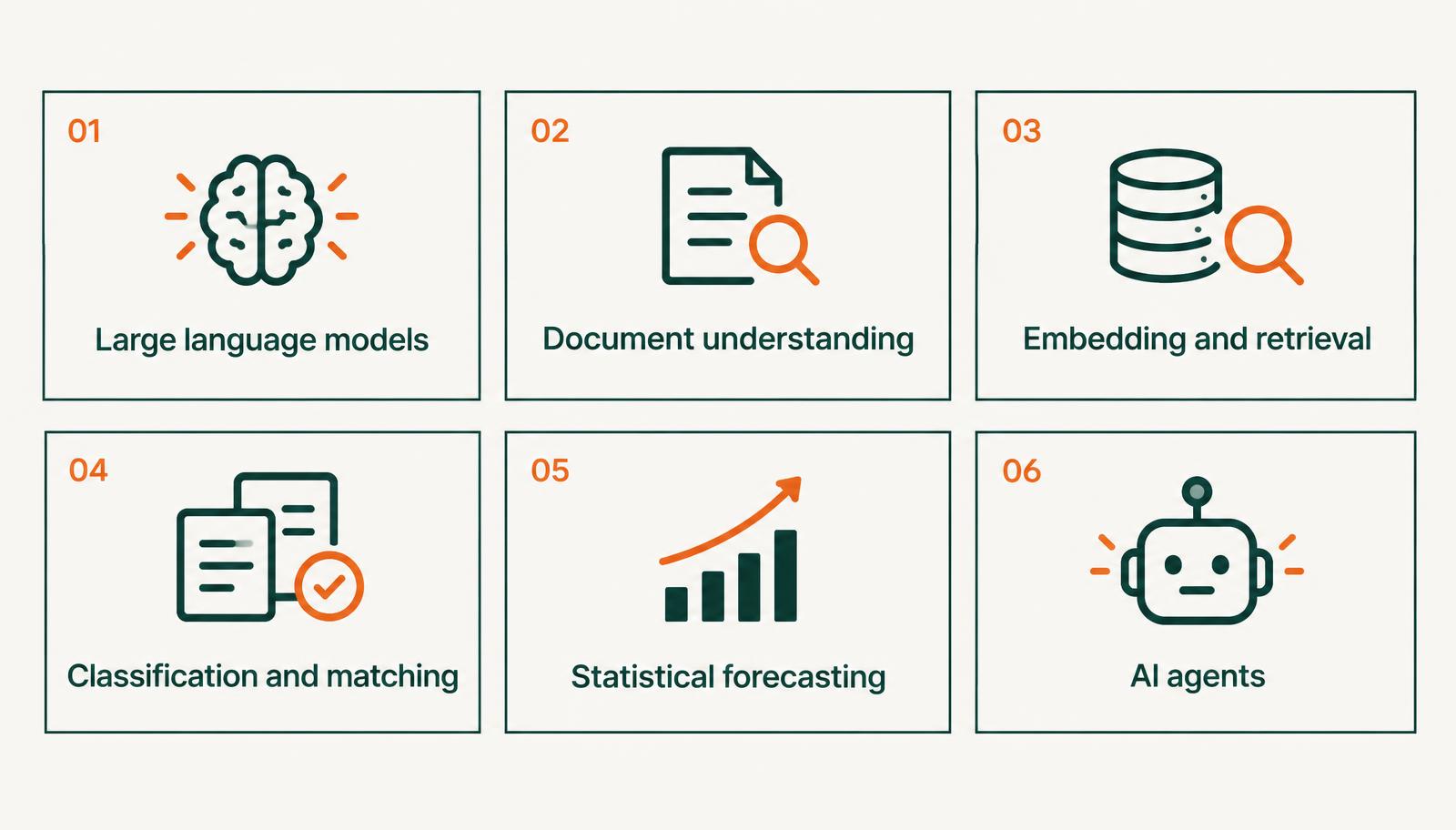
Six Types of AI Models and Systems Relevant to Venture Capital
Not every venture capital firm needs to develop all six capabilities internally.
However, understanding their differences helps investment teams evaluate what a proposed AI system can realistically accomplish.
| Model or System Type | Primary Function | Venture Capital Application |
|---|---|---|
| Large language models | Understand and generate language | Research summaries, investment briefs, document questions |
| Document understanding models | Extract information from files | Pitch decks, financial statements, contracts |
| Embedding and retrieval models | Find relevant information | Historical research, investment memos, institutional knowledge |
| Classification and matching models | Categorize and match records | Sector classification, company matching, screening support |
| Statistical and forecasting models | Analyze numerical patterns | Financial scenarios, portfolio monitoring, anomaly detection |
| AI agents | Coordinate defined tasks and tools | Research preparation, workflow routing, reporting assistance |
These capabilities are not mutually exclusive.
A useful investment workflow may combine several of them.
1. Large Language Models for Investment Research
Large language models, or LLMs, are designed to process and generate language.
They can help investment teams work with large volumes of written information.
For example, an associate may receive a pitch deck, founder notes, market research, and a financial overview.
An LLM can help organize the supplied information into a structured first-pass research brief.
That brief might cover:
- Company background
- Founder information
- Business model
- Market opportunity
- Product differentiation
- Competitive positioning
- Available financial information
- Potential investment risks
- Questions requiring further investigation
This can make research preparation more consistent.
However, generating a convincing summary is not the same as verifying the information.
A model may accurately summarize a founder's claim without establishing whether that claim is correct.
It may also omit qualifications, misunderstand financial terminology, or generate unsupported statements.
Where LLMs Work Well
LLMs are particularly useful for organizing qualitative information, preparing structured drafts, and helping analysts investigate documents.
They are less appropriate as the sole authority for financial calculations, valuations, or investment decisions.
For example, a model can explain the difference between TVPI and DPI.
But actual fund performance calculations should use authoritative cash flow and valuation records.
The investment team should also distinguish source-backed findings from model-generated interpretations.
2. Document Understanding Models for Pitch Decks and Financial Statements
Venture capital firms work with documents that rarely follow a consistent format.
A pitch deck may present revenue in a chart.
Another may contain financial information in a table.
A third may describe the company's traction in several paragraphs without providing a dedicated financial slide.
Document understanding models can help extract information from these different formats.
Depending on the system, they may process text, tables, images, and document layouts.
For example, a model might identify:
Company: Name, website, industry, and geography.
Founders: Names, roles, and relevant background.
Financial information: Reported revenue, expenses, and cash balances.
Financing information: Current fundraising plans and previous rounds.
Operating metrics: Customer numbers, growth rates, or other reported indicators.
The extracted information can then be organized for review.
Why Extraction Accuracy Matters
Consider a pitch deck containing these statements:
"Annual recurring revenue reached $1.2 million in September."
"Management expects ARR to reach $2 million by year-end."
A useful extraction system should recognize that these are different types of information.
One describes a reported historical result.
The other describes a management forecast.
If the system records both as actual revenue, the resulting investment analysis becomes unreliable.
This is why venture capital document processing should preserve reporting dates, definitions, source locations, and verification status.
The objective is not simply to extract more information.
It's to extract the right information without losing its meaning.
3. Embedding Models and Retrieval-Augmented Generation
Venture capital firms accumulate large amounts of historical information.
This includes investment memos, screening decisions, founder meeting notes, market research, and portfolio updates.
The information may remain useful for years.
However, finding it can be difficult when documents are spread across multiple repositories.
Embedding models help represent information in a form that supports semantic search.
This allows systems to retrieve relevant content based on meaning rather than relying exclusively on exact keyword matches.
For example, an investor might search:
"Which developer infrastructure companies did we pass on because of distribution concerns?"
A retrieval system could identify relevant historical investment records, even if those documents do not contain that exact wording.
What Is Retrieval-Augmented Generation?
Retrieval-augmented generation, or RAG, is a system design that combines information retrieval with a generative language model.
RAG is not itself a single AI model.
Instead, it allows a model to use relevant information retrieved from approved sources when generating an answer.
The CFA Institute's research on retrieval-augmented generation for financial document analysis examines how these systems work and where they can support financial research.
The research also highlights an important limitation: retrieving relevant information does not ensure the resulting answer will be accurate.
Performance depends on document quality, retrieval methods, model behavior, and how results are evaluated.
For venture capital firms, RAG can support institutional knowledge systems that retrieve previous research and provide references to the original documents.
However, permissions, document versions, and reporting dates still need to be handled correctly.
An internal investment memo written two years ago should not automatically be treated as a current assessment of a company.
For firms designing connected data environments, our article on AI-first VC operations stacks examines how institutional knowledge can move between investment workflows.
4. Classification and Matching Models for Investment Screening
Classification models assign information to predefined categories.
Matching systems help identify records or opportunities that may satisfy particular conditions.
Within venture capital, these capabilities can support company categorization, entity matching, and selected screening activities.
For example, a fund investing in enterprise software may want to categorize incoming companies according to sector, investment stage, geography, and business model.
A classification model could assist with organizing company information into those categories.
Another model might help identify whether a company already exists in the firm's database under a different name.
These tasks can improve the consistency of investment records.
However, they should not be confused with determining whether a company is a good investment.
Classification Is Not Investment Judgment
Consider an early-stage company developing software for healthcare organizations.
A classification model might identify the company as healthcare software.
That may be useful.
But the investment team may still need to determine whether the product fits the fund's thesis, whether the founders have relevant experience, and whether the company has a defensible position in its market.
Those assessments involve additional evidence and judgment.
Even a classification model trained on a fund's previous investment decisions may inherit historical inconsistencies or biases.
For example, a firm may have passed on companies because of temporary budget constraints rather than concerns about the underlying businesses.
Training a model to reproduce every previous decision could encode those circumstances as permanent investment preferences.
A more reliable approach is to define the information the model should classify and establish a clear process for reviewing ambiguous cases.
Our article on building a VC screening rubric explains how funds can document consistent initial evaluation criteria.
5. Statistical Models for Financial and Portfolio Analysis
Not every venture capital AI application requires a large language model.
Many financial analysis tasks are better served by statistical methods, conventional calculations, or specialized machine learning models.
These can be useful for examining numerical patterns, comparing reporting periods, and identifying unusual changes.
For example, a portfolio monitoring system may need to identify companies experiencing:
- Declining cash runway
- Revenue growth below plan
- Material changes in operating expenses
- Unexpected increases in customer concentration
- Missing financial reporting
- Unusual movements in working capital
Some of these tasks can be handled through straightforward calculations and rules.
Others may benefit from more sophisticated statistical methods.
The important consideration is whether the method is appropriate for the available data.
Why More Complex Isn't Always Better
Consider a venture-backed company with 18 months of historical financial information.
An investment team wants to understand whether its cash runway is deteriorating.
A complex machine learning forecasting model may not be justified by the available data.
A simpler analysis of current cash balances, historical spending, and management's forecast may provide more useful information.
AI can assist with organizing and explaining the results.
But the financial calculations should remain reproducible and subject to appropriate verification.
Our article on AI-assisted financial insights for PE and VC teams examines how investment professionals can investigate financial developments using approved evidence.
6. AI Agents for Multi-Step Investment Workflows
AI agents coordinate tasks that may involve several models, data sources, and software applications.
For venture capital firms, this can be relevant when work repeatedly moves between systems.
Consider an associate preparing a first-pass investment brief.
The process may require retrieving company information, reviewing a pitch deck, examining previous research, and preparing a summary according to the fund's screening criteria.
A properly designed agent could help coordinate these activities.
For example:
Retrieve: Access approved company documents and records.
Extract: Organize relevant information from those sources.
Research: Gather additional information from permitted sources.
Compare: Identify gaps relative to the firm's screening requirements.
Prepare: Produce a draft research brief.
Escalate: Send unresolved questions and the draft to the responsible investor.
The agent would not independently determine whether the firm should invest.
Its purpose would be to support the preparation and review process.
Why Agent Boundaries Matter
An agent that can retrieve information may not need permission to modify records.
An agent that can prepare draft research may not need permission to send external communications.
These distinctions should be deliberate.
The NIST Generative AI Risk Management Profile provides a broader framework for evaluating risks associated with generative AI systems.
For venture capital applications, important considerations include information integrity, confidentiality, reliability, and human oversight.
The ability to perform more actions should be accompanied by stronger controls, not weaker ones.
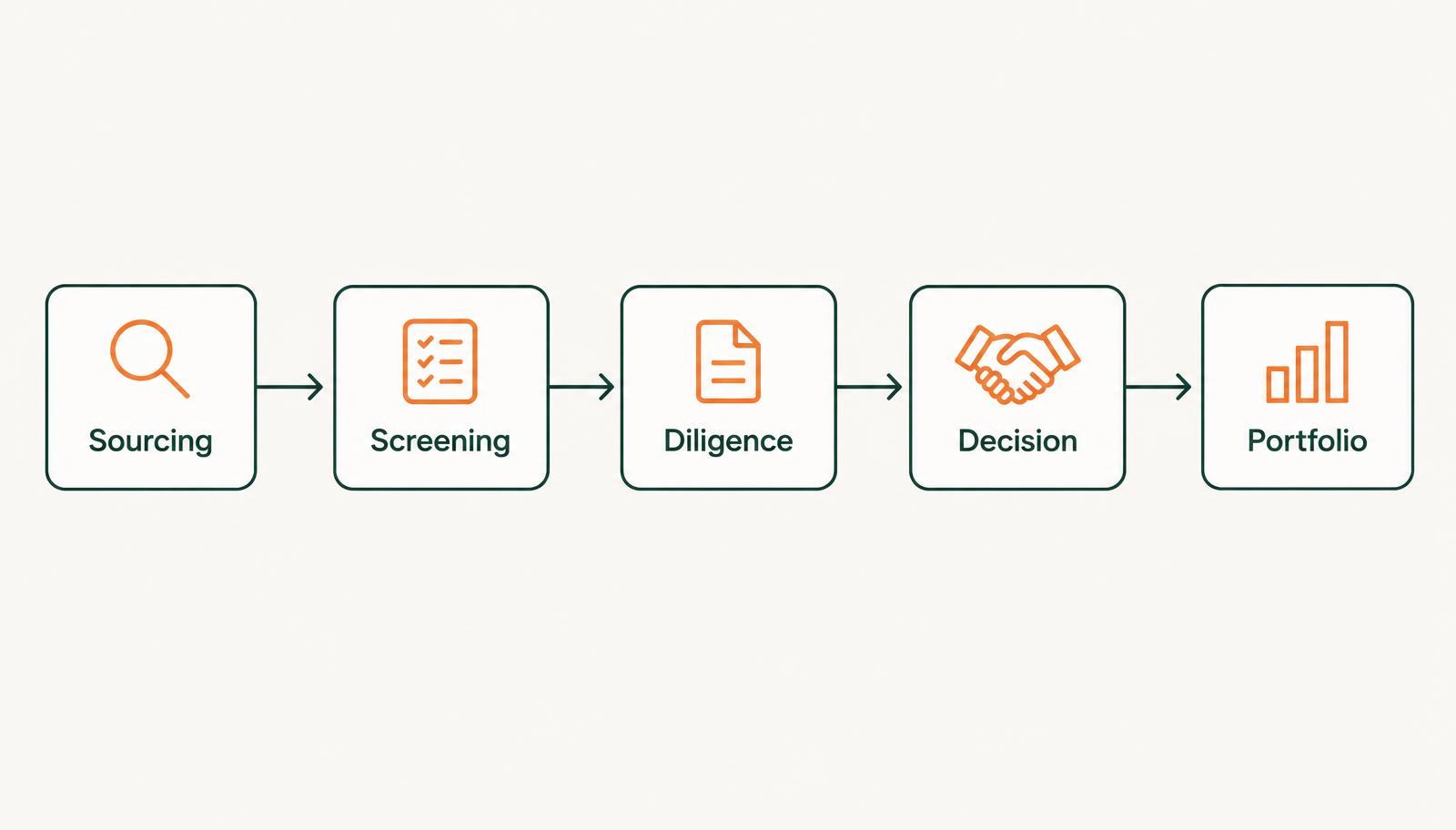
Which AI Models Fit Different VC Workflows?
The right technology depends on the information available and the output the investment team needs.
A useful way to evaluate AI adoption is to begin with the task rather than the model.
| Investment Workflow | Relevant AI Capabilities | Expected Output | Human Responsibility |
|---|---|---|---|
| Early-stage sourcing | Entity matching, classification, signal analysis | Companies worth investigating | Confirm thesis relevance |
| Deal intake | Document extraction, matching | Structured company records | Verify important fields |
| Initial screening | LLMs, retrieval, classification | Draft screening assessment | Evaluate fit and exceptions |
| Due diligence | Document understanding, RAG, LLMs | Source-backed research | Validate evidence and risks |
| Investment committee | Retrieval, language generation | Draft decision materials | Make investment decisions |
| Portfolio monitoring | Statistical analysis, extraction | Changes and exceptions | Interpret performance |
| LP reporting | Document processing, LLMs, workflow agents | Draft reporting materials | Approve financial information |
| Institutional knowledge | Embeddings, retrieval, LLMs | Relevant historical records | Interpret past context |
These are potential applications, not a prescription that every fund must deploy each technology.
A small seed-stage fund may benefit more from reliable document retrieval than from a complicated multi-agent system.
Another firm may have excellent research repositories but struggle with inconsistent portfolio reporting.
The appropriate implementation depends on the existing process.
Do Venture Capital Firms Need Proprietary AI Models?
Not necessarily.
The phrase "proprietary AI model" is often used loosely.
It can refer to different technical and contractual arrangements.
A firm might train a model from scratch.
It might fine-tune an existing model using specialized examples.
It might use a commercial foundation model with approved internal data.
Or it might commission a proprietary application that combines third-party models, retrieval systems, workflow logic, and fund-specific evaluation criteria.
These are different approaches.
Training a Model From Scratch
Training a large foundation model requires substantial data, infrastructure, and technical resources.
For most venture capital firms, creating a foundation model from scratch is unlikely to be the most practical starting point.
The firm's main advantage often lies in its investment process and institutional information rather than its ability to train a general-purpose language model.
Fine-Tuning an Existing Model
Fine-tuning adjusts an existing model using additional training examples.
This can be useful when a firm has a sufficiently large and consistent dataset and a repeatable task that benefits from specialized behavior.
However, fine-tuning is not automatically the right solution for providing a model with updated company information.
A model trained on historical research may still require access to current documents.
Fine-tuning also introduces maintenance and evaluation requirements.
Using Retrieval and Fund-Specific Workflows
For many investment research applications, a system built around an existing model and approved information sources may be more practical.
For example, a fund may want to retrieve previous screening decisions and apply its documented research criteria to new opportunities.
This can potentially be accomplished through a combination of retrieval, structured workflows, and model instructions.
The firm may retain control over defined application components and the delivery arrangements without owning the underlying foundation model.
That distinction should be clear in any development agreement.
What Current Research Suggests
The Cambridge Centre for Alternative Finance's 2026 Global AI in Financial Services Report found that 63% of surveyed financial services industry respondents used internal workflows built on external foundation models.
The research covered the broader financial services industry, not venture capital firms specifically.
It nevertheless illustrates an important point: organizations can develop internal AI capabilities without training every underlying model themselves.
For venture capital firms, the more useful question is often:
What part of our investment process needs to be specific to our firm, and what can we reliably use from existing technology?
Why General-Purpose AI Models Are Not Enough on Their Own
General-purpose models can be useful for research and document preparation.
But making them reliable within a venture capital firm's operations requires additional design.
1. Access to Relevant Information
A model cannot reliably analyze internal documents it cannot access.
It also cannot be expected to know information that became available after its training.
For example, an investment team may want to compare a founder's current fundraising plans with a conversation held 18 months earlier.
That requires access to the historical information.
The model's general knowledge is not a substitute.
2. Understanding the Fund's Investment Criteria
Different venture capital firms evaluate opportunities differently.
One may prioritize technical founders building infrastructure software.
Another may focus on regulated healthcare businesses.
A third may invest across several industries but follow strict geographic or ownership requirements.
A useful AI workflow should reflect the firm's documented criteria.
It should also recognize when those criteria do not provide a definitive answer.
3. Source Traceability
Investment research needs to distinguish company claims from independently supported findings.
Consider an AI-generated statement that a startup has a particular market share.
The investment team needs to know where that information originated.
Was it reported by the founder?
Was it calculated internally?
Did it come from a third-party research provider?
Without an identifiable source, the statement may be inappropriate for an investment committee memo.
4. Information Security
Venture capital firms handle confidential company information, investor communications, and internal investment decisions.
Any AI system accessing this information should operate within the firm's approved permissions and data-handling requirements.
Access to a document should not automatically give an AI agent permission to distribute or modify it.
5. Reliable Handling of Exceptions
Investment information is often incomplete.
A founder may decline to share certain financial information.
Two documents may report different figures.
A company may not fit neatly into the fund's screening categories.
An AI system should identify these situations rather than manufacture a complete answer.
A reliable workflow needs a defined way to handle uncertainty.
How Should VC Firms Evaluate AI Model Performance?
Selecting an AI model based on a public benchmark is not enough.
A model may perform well on general reasoning tests while struggling with the documents and tasks used by a particular investment team.
The better approach is to evaluate it against representative work.
Example: Testing an AI Screening Workflow
Suppose a venture capital firm wants to automate preparation of initial company screening briefs.
The firm could assemble a representative sample of previously reviewed opportunities.
The sample should include straightforward cases, ambiguous companies, incomplete documents, and businesses outside the fund's mandate.
The investment team would then establish expected outputs and evaluation criteria.
A practical assessment might include:
| Evaluation Area | What to Test |
|---|---|
| Information extraction | Were company facts captured correctly? |
| Source accuracy | Can important claims be traced to evidence? |
| Thesis relevance | Were the fund's criteria applied appropriately? |
| Missing information | Did the system identify unresolved questions? |
| Unsupported claims | Did it introduce information absent from the sources? |
| Consistency | Does it handle comparable cases reliably? |
| Human correction | How much work is required to fix the output? |
| Workflow completion | Does the output support the next review stage? |
The investment team should also test the system using cases it did not rely on during development.
Otherwise, the evaluation may overstate performance.
Measure More Than Speed
A system that produces a research brief in two minutes may appear efficient.
But if an associate spends 20 minutes correcting it, the benefit is smaller than it first appears.
Likewise, an AI workflow that produces more company summaries is not necessarily improving deal sourcing.
The relevant question is whether it helps investors review more suitable opportunities with reliable information.
A useful evaluation should consider accuracy, time saved after corrections, team adoption, and the cost of operating the system.
The objective is dependable workflow performance rather than impressive demonstrations.
How Sonexa Labs Approaches AI Models for Venture Capital
Sonexa Labs is an applied AI lab developing models and agents around individual venture capital firms' investment strategies, approved data, and internal processes.
Rather than requiring every firm to adopt the same technology, Sonexa's approach begins with the workflow.
For example, one fund may want to improve initial screening.
Another may need to organize historical diligence information.
A third may want to develop more consistent portfolio research and reporting processes.
These requirements may involve different combinations of models, retrieval systems, structured data processing, and AI agents.
Fund-Specific Models and Agents
Through Sonexa Labs' Tailored Solutions, firms can explore commissioned AI systems designed around agreed investment workflows.
A screening engagement might involve document extraction, retrieval of approved research, and preparation of structured briefs.
An institutional knowledge engagement might focus on finding historical investment records and preserving their original context.
A portfolio workflow could involve extracting approved company information and identifying reporting gaps.
These are potential commissioned engagements, not a claim that every capability is available as a standardized product.
Design, Test, and Review
Sonexa's development approach includes understanding the workflow, defining permitted inputs, designing the system, validating outputs, and agreeing on delivery requirements.
The evaluation should reflect the firm's real use cases.
For example, a model preparing investment research should be assessed for evidence accuracy, missing information, and the usefulness of its outputs to the investment team.
Final investment decisions remain with the firm's authorized professionals.
Where Juno Fits
Sonexa also offers Juno as a standalone product focused on early-company discovery.
Juno is designed to help investment teams identify, track, enrich, and engage with emerging companies before fundraising.
It addresses a narrower sourcing requirement.
It should not be confused with a complete investment research system or the broader commissioned AI capabilities offered by Sonexa Labs.
A fund may evaluate Juno for early discovery while separately considering tailored AI workflows for screening, research, or other internal processes.
Conclusion: The Right Model Depends on the Investment Task
There is no single AI model that solves every venture capital workflow.
Language models can help organize research.
Document understanding models can extract information from pitch decks and financial reports.
Retrieval systems can make institutional knowledge easier to access.
Classification models can support structured screening.
Statistical methods can help identify financial developments, while AI agents can coordinate defined tasks across systems.
The important question is not which model has the most capabilities.
It is which combination of technology, approved data, and review procedures helps the investment team perform a specific task more reliably.
For some firms, that may mean using existing AI software.
For others, it may involve developing a system around their own investment criteria and internal information.
Sonexa Labs develops fund-specific AI models and agents around venture capital investment workflows, including sourcing intelligence, screening, research, portfolio information, and institutional knowledge.
Book a Demo to explore how tailored AI models and agents could support your firm's investment process.
Frequently Asked Questions
What are the main types of AI models used in venture capital?
Relevant technologies include large language models, document understanding models, embedding models, classification systems, statistical models, and AI agents. Different combinations support sourcing, screening, research, portfolio monitoring, and fund operations.
What is the best AI model for venture capital?
There is no universally best model. The appropriate choice depends on the task, available information, required accuracy, integration requirements, and level of human oversight. A research summarization workflow may need different technology from a company classification or financial monitoring process.
Can venture capital firms build proprietary AI models?
Yes. Firms can develop specialized AI systems, fine-tune existing models, or build applications around approved information and third-party foundation models. Training a foundation model from scratch is not necessary for many fund-specific applications.
What is the difference between an AI model and an AI agent?
An AI model performs inference or generates an output. An AI agent coordinates defined tasks using models, data sources, and software tools. Agents can automate multiple steps but still require reliable information, appropriate permissions, and review controls.
Can AI models identify promising startups?
AI can help identify emerging companies, organize signals, and evaluate whether available information aligns with a fund's criteria. However, these systems cannot reliably predict future investment performance or determine which companies will succeed.
Can AI models conduct venture capital due diligence?
AI models can assist with extracting documents, retrieving relevant evidence, identifying discrepancies, and preparing draft research. Investment professionals remain responsible for validating findings and making decisions.
Is retrieval-augmented generation useful for VC firms?
Yes. RAG can help investment teams retrieve approved historical research, investment memos, and other internal records when preparing analysis. Its reliability depends on document quality, retrieval performance, access controls, and evaluation.
Does a VC firm need its own foundation model?
Usually not as a starting point. Many useful investment workflows can be developed around existing models with approved data, retrieval systems, and fund-specific procedures. The appropriate architecture depends on the task and the firm's technical requirements.
How should VC firms measure AI model accuracy?
Firms should test models using representative investment cases and measure information accuracy, source traceability, missing information, unsupported claims, correction rates, and workflow usefulness. Evaluation should include difficult and previously unseen cases.
How does Sonexa Labs develop AI models for venture capital?
Sonexa Labs develops commissioned AI models and agents around individual firms' investment processes. Engagements are scoped according to workflow requirements, approved data, evaluation criteria, permissions, and agreed deliverables.