VC Compliance Documents: What AI Can Check and Prepare
A venture capital firm is preparing to close its next fund.
The legal team has finalized the limited partnership agreement. Subscription documents are coming in from investors. Some LPs have negotiated side letters with additional reporting requirements.
Meanwhile, the operations team is collecting investor information, tracking outstanding documentation, and coordinating with the fund administrator.
One investor's subscription agreement is missing a required attachment. Another has submitted an outdated version of a document. A third has negotiated terms that need to be reflected in future investor communications.
None of these issues necessarily requires sophisticated financial analysis.
But someone needs to identify them, determine who is responsible, and make sure they are resolved before the next step.
This is where compliance document automation can help.
AI can help venture capital firms extract information from compliance documents, identify missing records, compare documents against approved requirements, and prepare materials for review. It cannot independently establish legal compliance or replace the professionals responsible for regulatory decisions.
The distinction is important.
Automating the preparation and checking of compliance documents is different from automating compliance itself.
This article examines the document workflows that venture capital firms can automate, the software available, and the controls needed to make those workflows reliable.
What Is Compliance Document Automation for Venture Capital?
Compliance document automation involves using software to organize, process, check, and manage documentation associated with a venture capital firm's legal, regulatory, and contractual obligations.
Depending on the firm's structure, these documents may include investor subscription agreements, side letters, compliance policies, regulatory filings, investor verification materials, and records supporting required reviews.
Automation can involve several types of technology.
Document processing extracts information from PDFs, agreements, forms, and other files.
Rules-based automation checks whether required information is present or whether a document meets defined conditions.
AI-assisted review helps identify relevant clauses, compare documents, and flag potential inconsistencies.
Workflow automation coordinates tasks, approvals, reminders, and document distribution.
These capabilities can be combined, but they serve different purposes.
For example, extracting an investor's legal name from a subscription agreement is a document-processing task.
Determining whether that investor satisfies a particular legal requirement may involve additional evidence, legal interpretation, and professional review.
A reliable system should not confuse the two.
Which Compliance Documents Do VC Firms Manage?
The exact requirements depend on the fund's jurisdiction, legal structure, adviser registration status, investors, and contractual obligations.
Common document categories include:
| Document Category | Examples | Potential Automation |
|---|---|---|
| Fund formation | Limited partnership agreements, amendments, organizational documents | Version management and clause retrieval |
| Investor onboarding | Subscription agreements, questionnaires, identity documents | Completeness checks and data extraction |
| Investor arrangements | Side letters, reporting commitments, negotiated terms | Obligation identification and exception tracking |
| Regulatory filings | Applicable registration and offering filings | Deadline tracking and draft information preparation |
| Compliance programs | Policies, procedures, annual review records | Version comparison and evidence organization |
| Employee compliance | Code of ethics acknowledgments, certifications, disclosures | Collection, reminders, and completion tracking |
| Investor communications | Approved notices, disclosures, and supporting records | Document preparation and distribution checks |
| Recordkeeping | Required books, records, and review evidence | Indexing, retrieval, and retention workflow support |
Not every document is legally required for every venture capital firm.
A firm's compliance team and legal advisers should determine the applicable requirements before automation rules are configured.
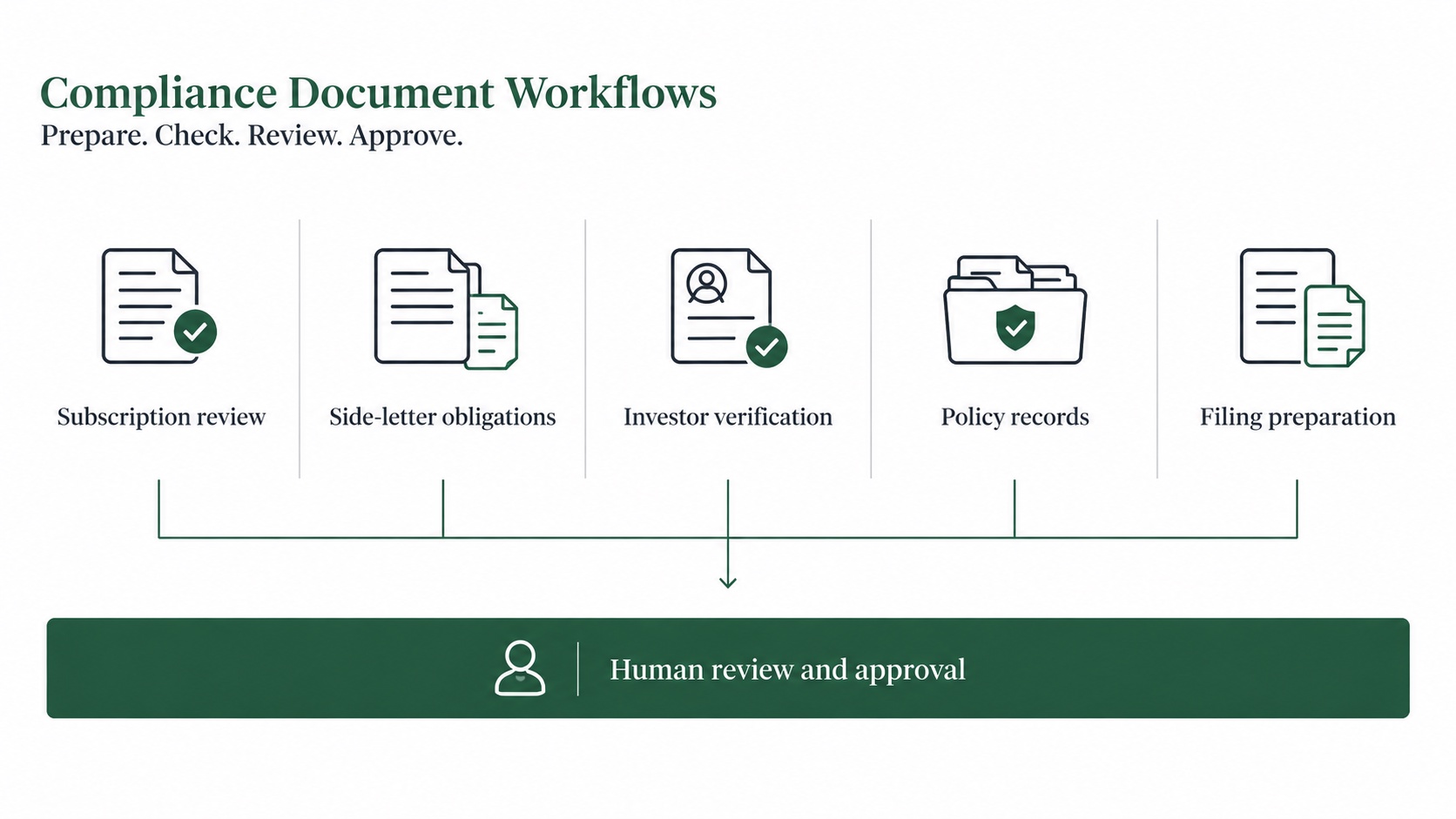
Five VC Compliance Document Workflows Worth Automating
The strongest opportunities involve repetitive work with clearly defined inputs, expected outputs, and review responsibilities.
These are the workflows where AI can assist without being asked to make legal decisions independently.
1. Reviewing Investor Subscription Documents
Subscription agreements are a practical starting point for document automation.
During fundraising, investors may need to provide information about their legal entities, investment commitments, eligibility, and other matters relevant to the offering.
The required documentation varies according to the fund and investor.
When investors complete these materials manually, operational teams may need to review large numbers of documents for missing or inconsistent information.
AI-assisted processing can help organize that work.
For example, a system could extract:
- Investor legal name
- Entity type
- Commitment amount
- Contact information
- Relevant document dates
- Signature status
- Required attachments
- Selected questionnaire responses
It could then compare the extracted information against an approved checklist.
If a required attachment is missing, the system could flag the issue.
If two documents contain different legal entity names, it could request review.
What AI should not do: Independently determine investor eligibility, approve a subscription, or conclude that the transaction satisfies all applicable legal requirements.
Those decisions belong to the responsible fund professionals and legal advisers.
2. Identifying Obligations in Side Letters
Side letters can create additional operational complexity.
Investors may negotiate different reporting, notification, fee, or other contractual arrangements.
Those arrangements need to be understood and managed alongside the fund's governing documents.
The challenge becomes more significant when a fund has multiple investors with different negotiated terms.
Consider a hypothetical fund with 25 LPs.
Most investors receive the firm's standard quarterly reporting package.
However, one investor has negotiated an additional information requirement, while another has a specific notification provision.
If those obligations remain buried in signed documents, the operations team may struggle to identify which requirements apply to each investor.
AI can help extract and organize potentially relevant provisions.
A workflow might prepare a structured record containing:
| Field | Example |
|---|---|
| Investor | LP A |
| Document | Executed side letter |
| Provision | Additional reporting obligation |
| Referenced section | Section identified in source |
| Potential operational impact | Additional investor communication |
| Review status | Pending legal confirmation |
| Responsible team | Legal / Investor Relations |
The system could also identify potentially conflicting language across documents.
However, it should not independently determine the legal meaning or enforceability of a provision.
Why Human Review Matters
Contractual obligations depend on the actual language, surrounding agreements, amendments, and legal context.
For example, a side letter provision may be subject to conditions established elsewhere in the fund documents.
An AI system that extracts one sentence without considering those conditions could produce an incomplete interpretation.
The correct approach is to provide the relevant source language, identify the possible obligation, and route it to the appropriate reviewer.
Once confirmed, the obligation can become part of an approved operational tracking process.
This allows the firm to automate follow-up tasks without relying on an unverified legal interpretation.
3. Organizing Investor Verification and AML/KYC Materials
Investor onboarding may also involve identity verification, beneficial ownership information, sanctions screening, and other checks.
The applicable requirements depend on the fund, jurisdiction, service providers, and regulatory framework.
Automation can help collect documents, organize information, track missing materials, and support review processes.
For example, a workflow could identify whether an investor has supplied the documentation required by the firm's approved onboarding checklist.
It could also organize verification results generated by an authorized provider.
However, an AI document-processing system should not independently determine that an investor has satisfied all applicable AML/KYC requirements.
Screening decisions and risk assessments require the appropriate systems, policies, and human oversight.
An Important U.S. Regulatory Distinction
In December 2025, FinCEN announced a final rule delaying the effective date of its investment adviser AML/CFT requirements from January 1, 2026, to January 1, 2028.
The rule concerns specified registered investment advisers and exempt reporting advisers.
That means firms should not treat those particular FinCEN requirements as having become effective in January 2026.
The official FinCEN announcement explains the postponement.
This does not mean all investment funds are free of AML/KYC obligations.
Other applicable laws, contractual arrangements, service-provider requirements, and jurisdiction-specific obligations may still apply.
A VC firm's compliance team should establish the actual requirements before introducing automation.
4. Maintaining Compliance Policies and Review Records
Investment advisers may be required to maintain written compliance policies, conduct periodic reviews, and retain supporting documentation.
For SEC-registered investment advisers, Rule 206(4)-7 requires written compliance policies and procedures and reviews of their adequacy and effectiveness at least annually.
The corresponding recordkeeping requirements include maintaining records documenting those reviews.
The SEC's compliance program requirements explain the underlying framework.
For VC firms subject to these requirements, AI-assisted document workflows can support the administrative preparation involved in compliance reviews.
For example, a system could:
- Retrieve the current approved policy
- Identify previous versions
- Organize supporting review documents
- Compare changes between policies
- Identify missing acknowledgments
- Track outstanding review tasks
- Prepare a draft evidence register
- Flag review activities without supporting documentation
These capabilities can make information easier to locate and organize.
But they do not establish whether a compliance program is adequate or effectively implemented.
That assessment remains the responsibility of the appropriate compliance professionals.
Why Documentation Matters
The SEC's Division of Examinations highlighted deficiencies in adviser annual compliance reviews in September 2026.
Its observations included issues involving incomplete procedures, insufficient review documentation, and failures to address identified deficiencies.
For investment firms, the operational lesson is straightforward.
Completing a checklist is not the same as demonstrating that a required review occurred and that identified issues were appropriately addressed.
An automated system should help preserve evidence of the actual review process.
It should not generate documentation suggesting that tests or approvals occurred when they did not.
5. Preparing Regulatory Filing Information
Some venture capital firms and their associated entities must prepare regulatory filings.
The obligations vary based on the firm's registration status, investment activities, offering structure, and jurisdiction.
Automation can support selected preparation tasks.
For example, a workflow could retrieve approved information, populate draft fields, track deadlines, and identify missing supporting documents.
However, regulatory filings require particular care.
Example: Form D
For relevant U.S. offerings relying on Regulation D, Form D is generally required within 15 calendar days after the first sale of securities.
The SEC's Form D guidance explains the filing requirements.
An automation workflow could help the responsible team maintain the applicable filing calendar and prepare a checklist of required information.
However, it should not independently decide whether the offering qualifies for a particular exemption.
It should also not submit a filing without the appropriate authorization and review.
The correct workflow is to organize approved information and support the responsible professionals in completing the filing.

Which Compliance Activities Should Remain Under Human Control?
The distinction between automation and professional responsibility should be defined before implementing a system.
| Activity | AI-Assisted Task | Human Responsibility |
|---|---|---|
| Subscription review | Extract fields and flag missing documents | Confirm completeness and acceptance |
| Investor verification | Organize documents and screening results | Make required compliance determinations |
| Side-letter review | Identify provisions and potential obligations | Interpret and approve contractual requirements |
| Policy maintenance | Compare versions and organize records | Approve policy changes |
| Annual compliance review | Prepare checklists and evidence registers | Conduct and document substantive assessments |
| Regulatory filings | Prepare draft information and track deadlines | Validate and authorize submissions |
| Marketing materials | Identify unsupported claims or missing evidence | Approve communications under applicable requirements |
| Record retention | Classify, index, and retrieve documents | Establish and enforce retention obligations |
The key design principle is that AI can prepare information for a compliance decision without becoming the authority making that decision.
This distinction should be reflected in user permissions, workflow triggers, and approval requirements.
Compliance Automation Software: Four Different Approaches
Venture capital firms can evaluate several categories of software.
Some products focus on investor onboarding. Others provide regulatory compliance management or broader agreement workflows.
The appropriate platform depends on the documents the firm needs to manage.
| Platform | Primary Focus | Relevant Capabilities | What to Evaluate |
|---|---|---|---|
| Passthrough | Investor onboarding | Subscription documents, KYC/AML workflows, investor data collection | Fund-specific onboarding requirements |
| Juniper Square | Private markets investor operations | Digital subscriptions, investor verification workflows, reporting | Integration with existing fund operations |
| COMPLY | Financial services compliance management | Policies, attestations, employee compliance, monitoring | Applicable adviser compliance requirements |
| Docusign CLM | Contract lifecycle management | Agreement review, clause extraction, approval routing, records | Suitability for fund-specific agreements |
These platforms are not direct substitutes. The comparison reflects publicly documented capabilities, not hands-on product testing.
Passthrough: Subscription Documents and Investor Onboarding
Passthrough, now part of iCapital, provides software for investor onboarding and related document workflows.
Its offering includes electronic subscription agreements and KYC/AML capabilities.
The platform can help collect investor information, organize documents, and coordinate the subscription process.
Its electronic subscription document platform is relevant for fund managers seeking to reduce manual onboarding work.
Where it fits: Funds that need a more structured process for collecting, reviewing, and completing investor subscription materials.
What to verify: Supported document structures, investor verification requirements, approval procedures, and integration with the fund administrator.
Juniper Square: Investor Operations and Documentation
Juniper Square provides software and services for private markets fund operations.
Its investor onboarding capabilities include digital subscriptions, document collection, investor information management, and AML/KYC workflows.
For firms already using Juniper Square for fund administration or investor relations, this may create opportunities to manage onboarding information within the same environment.
The platform's investor onboarding capabilities include configurable subscription workflows and permission controls.
Where it fits: Venture capital firms seeking to connect investor onboarding with broader fund operations.
What to verify: Which capabilities are included in the proposed package, how verification decisions are handled, and which records remain authoritative.
COMPLY: Adviser Compliance and Internal Controls
COMPLY provides regulatory compliance software for financial services firms, including investment advisers and private fund managers.
Its platform includes employee compliance, policy management, certifications, attestations, communications archiving, and related monitoring capabilities.
Its compliance platform also offers AI-assisted access to approved policy information.
Where it fits: Firms that need structured internal compliance processes, employee attestations, and documented review activities.
What to verify: Whether the system supports the firm's actual regulatory status and compliance program rather than a broader set of functions the firm does not require.
Docusign CLM: Agreement Review and Contract Workflows
Docusign CLM focuses on contract lifecycle management.
Its capabilities include agreement preparation, review, approval routing, document storage, and AI-assisted contract analysis.
The platform can help teams extract selected contractual terms and organize agreement workflows.
Its contract lifecycle management software may be relevant when a firm manages significant volumes of agreements.
Where it fits: Legal and operations teams that need more structured contract management processes.
What to verify: Whether the platform can accommodate specialized fund documents, approval requirements, and negotiated investor arrangements.
A general contract management platform should not automatically be treated as a specialized venture capital compliance system.
The Biggest Risk: Treating AI Output as Compliance Evidence
One of the most important risks in compliance automation is allowing generated information to become part of the official record without appropriate verification.
Consider an AI system reviewing an investor subscription agreement.
The system reports:
"All required documents are complete."
However, the agreement contains a required attachment that was omitted.
If the operations team accepts the AI summary without review, the system has created false confidence.
The problem isn't simply that the AI made a mistake.
It's that the workflow allowed an unverified conclusion to become an accepted compliance status.
What Reliable Automation Should Produce
Instead of a general declaration of compliance, a useful output should identify:
Document reviewed: The specific file and version.
Checks performed: The approved checklist or rules applied.
Information found: The relevant fields or provisions.
Evidence: Where the supporting information appears.
Exceptions: Missing, conflicting, or ambiguous information.
Review status: Whether an authorized professional has accepted the result.
This approach makes the output more useful to compliance teams.
It also creates a clearer distinction between automated checks and final decisions.
Why Audit Trails Need More Than Timestamps
An audit trail should make it possible to reconstruct important activities.
For example:
Who uploaded the document?
Which version was reviewed?
What information was extracted?
Which exceptions were identified?
Who approved the result?
Was the document later amended?
A timestamp alone may not explain how an important compliance decision was reached.
A useful system should preserve enough context for authorized reviewers to understand the process.
Recordkeeping Requirements Must Shape the System
Compliance document automation should not begin with selecting an AI model.
It should begin with understanding which records the firm must retain and how they need to be preserved.
For SEC-registered investment advisers, Rule 204-2 establishes books-and-records requirements covering specified categories of information.
The applicable retention periods and storage requirements depend on the records involved.
An automated system should not assume that simply saving a generated summary satisfies those requirements.
The underlying records may still need to be retained in their required form.
Similarly, firms subject to the SEC investment adviser marketing rule have recordkeeping obligations associated with covered advertisements and supporting information.
The SEC's investment adviser marketing guidance provides additional information about these requirements.
Don't Build Around Rules That Are No Longer in Effect
Regulatory requirements also change.
For example, the U.S. Court of Appeals for the Fifth Circuit vacated the SEC's 2023 private fund adviser rules in June 2024.
The SEC subsequently confirmed the vacatur.
An automation system designed around requirements from those vacated rules could impose unnecessary or incorrect procedures.
At the same time, the vacatur did not eliminate all existing adviser obligations.
The system's compliance requirements should come from a current, approved obligations register maintained by qualified professionals, not from an AI model's general knowledge of regulations.
This is especially important for funds operating across multiple jurisdictions.
How to Build an AI Compliance Document Workflow
Consider a venture capital firm preparing for a fund closing.
The firm wants to reduce the manual work involved in checking subscription documents and tracking outstanding information.
A properly scoped workflow could follow six stages.
| Stage | Activity | Responsible Party |
|---|---|---|
| 1 | Receive investor documents | Investor / Operations |
| 2 | Identify document type and version | Automated processing |
| 3 | Extract required information | AI-assisted processing |
| 4 | Compare against approved requirements | Automated checks |
| 5 | Review exceptions and legal questions | Compliance / Legal |
| 6 | Approve, record, and archive | Authorized fund personnel |
Step 1: Establish Approved Requirements
The legal and compliance teams define the documents and information required for the relevant investor or transaction.
These requirements should be recorded in a structured checklist.
The workflow should not generate its own legal requirements.
Step 2: Identify the Correct Documents
The system determines which documents have been submitted and checks their apparent versions.
It may identify missing attachments or documents that do not match the approved set.
Uncertain classifications should be flagged.
Step 3: Extract Information
The system organizes relevant information from the submitted documents.
For example, it could identify the investor's name, entity type, commitment amount, and execution status.
Each material extracted value should retain a reference to its source.
Step 4: Run Completeness Checks
The workflow compares the extracted information against the approved checklist.
It flags missing fields, contradictory information, and outstanding documents.
Step 5: Route Exceptions
Issues requiring interpretation move to the appropriate legal or compliance reviewer.
For example, a non-standard side-letter provision should not be automatically accepted because it resembles an approved clause.
Step 6: Preserve the Approved Record
Once the responsible team completes its review, the system records the approval and stores the relevant documents according to the fund's retention requirements.
Any later amendment should be managed as a new version with its own review history.
The objective is a repeatable process with clear evidence of what was checked and approved.
What Should VC Firms Evaluate Before Buying Compliance Automation Software?
Before purchasing a platform or commissioning a custom system, firms should test a representative document workflow.
The evaluation should include more than a successful demonstration using clean, standardized files.
| Evaluation Area | Questions to Ask |
|---|---|
| Document accuracy | Can the system extract information correctly from real fund documents? |
| Version control | Does it distinguish drafts, executed documents, and amendments? |
| Source traceability | Can reviewers locate the original language supporting each finding? |
| Exception handling | Does it flag uncertainty rather than invent an answer? |
| Approval controls | Can legal and compliance teams approve or reject outputs? |
| Access permissions | Can sensitive investor records be restricted? |
| Record retention | Does the system support the firm's approved retention requirements? |
| Integrations | Can approved information move to existing fund systems? |
| Monitoring | Are failed or incomplete workflows visible? |
| Cost | What are the complete implementation and operating costs? |
Test Realistic Failure Scenarios
A useful evaluation should include documents with:
- Missing signatures
- Incomplete investor information
- Conflicting entity names
- Superseded agreement versions
- Non-standard side-letter provisions
- Missing attachments
- Scanned or poorly formatted pages
- Ambiguous contractual language
A system that handles standard documents well may still struggle with these situations.
The right response is not always to produce an answer.
Sometimes the correct outcome is to stop processing and request review.
When Does Custom AI Make Sense for VC Compliance Documents?
Many compliance document workflows can be supported by existing software.
A fund primarily seeking digital subscription documents may find that a specialized onboarding platform provides what it needs.
An adviser seeking employee attestations and compliance monitoring may require a dedicated regulatory compliance application.
Custom AI becomes more relevant when the workflow depends on the firm's own document structures, internal systems, and review procedures.
For example, a fund may want to extract information from executed side letters and prepare an obligation register for legal confirmation.
Another may want to connect approved compliance documentation with its existing fund operations environment.
A third may need to organize historical policies and supporting records so authorized compliance professionals can retrieve them more efficiently.
These are specialized information-processing requirements.
However, custom AI should not replace regulatory compliance software or qualified legal review simply because the workflow can be automated.
The implementation needs a clearly defined purpose and measurable operating benefit.
How Sonexa Labs Approaches Compliance-Related Fund Workflows
Sonexa Labs develops fund-specific AI models and agents around venture capital firms' investment strategies, information, and internal processes.
The company is not positioned as a standalone regulatory compliance platform or legal services provider.
However, its commissioned AI approach can be relevant to document-heavy operational workflows.
Supporting Existing Fund Operations
Through its Fund Operations & LP Reporting offering, Sonexa can explore defined workflows that organize approved information and prepare materials for internal review.
For example, a fund could commission an AI system that helps identify missing inputs or assemble supporting documentation.
The implementation would depend on the firm's requirements, approved information sources, and agreed deliverables.
Organizing Institutional Knowledge
Compliance teams may also need access to historical documents, policy versions, and previously approved records.
Sonexa's Institutional Knowledge & Firm Operations offering addresses the development of systems that organize and retrieve approved internal information.
A commissioned workflow could help authorized users locate relevant records while preserving document versions and source references.
Building Around Existing Controls
Sonexa's broader Tailored Solutions approach allows firms to scope AI systems around particular operational requirements.
Any compliance-related implementation would need to respect the firm's existing recordkeeping systems, access controls, legal review processes, and approval authorities.
The purpose would be to support information preparation and workflow coordination, not to determine regulatory compliance independently.
For a broader look at how these systems fit within a firm's infrastructure, see our article on building an AI-first VC operations stack.
How to Measure Compliance Document Automation
The value of an AI-assisted compliance workflow should be measured by the quality of the complete process.
A faster document review is not necessarily an improvement if it produces more errors or requires extensive corrections.
Relevant performance indicators include:
| Metric | What It Measures |
|---|---|
| Document processing time | Time required to prepare records for review |
| Extraction accuracy | Correctness of information captured |
| Missing-document detection | Ability to identify incomplete submissions |
| False exception rate | How often valid information is incorrectly flagged |
| Missed exception rate | How often material issues are not identified |
| Human correction time | Work required after automated processing |
| Approval turnaround | Time from submission to authorized decision |
| Record completeness | Whether required evidence is retained |
| Traceability | Ability to reconstruct document review history |
| Operating cost | Total cost of software, maintenance, and review |
For compliance workflows, missed material issues and reliable evidence matter more than the number of documents processed.
A successful implementation should make the work easier for qualified professionals while preserving their ability to understand, challenge, and approve the results.
Conclusion: Automate the Paperwork, Not the Compliance Decision
Venture capital firms manage documents that affect investor relationships, regulatory obligations, fund operations, and internal controls.
Many of the surrounding administrative tasks are repetitive.
AI can help extract information, organize records, identify missing documents, compare provisions, and prepare review materials.
But automation should not be mistaken for compliance.
A system that finds a clause has not necessarily interpreted it correctly.
A system that completes a checklist has not necessarily established that a regulatory requirement has been satisfied.
And an AI-generated compliance summary should never replace the actual records and professional reviews required by the firm.
The strongest approach is to identify one document-heavy workflow, establish approved requirements, and introduce automation with clear exception handling and human approval.
Sonexa Labs develops fund-specific AI models and agents around venture capital firms' investment and operational workflows, including document processing, institutional knowledge, and fund operations.
Book a Demo to explore how Sonexa can support your firm's document-heavy operational processes.
Frequently Asked Questions
Can venture capital firms automate compliance documents with AI?
Yes. AI can assist with extracting information, identifying missing documents, comparing agreement provisions, organizing records, and preparing materials for review. Legal and regulatory decisions still require qualified human oversight.
What are the main compliance documents managed by VC firms?
Depending on the fund's structure and obligations, documents may include subscription agreements, limited partnership agreements, side letters, investor verification materials, regulatory filings, compliance policies, employee certifications, and supporting records.
What automation tools are available for venture capital compliance documents?
Passthrough and Juniper Square support investor onboarding workflows. COMPLY provides regulatory compliance management capabilities, while Docusign CLM supports agreement review and contract management. These platforms address different requirements rather than providing interchangeable solutions.
Can AI review venture capital side letters?
AI can extract potentially relevant provisions, identify differences between documents, and prepare an obligation register. However, qualified legal professionals should review the interpretation and applicability of contractual terms before they become operational requirements.
Can AI automate AML/KYC checks for VC funds?
Software can help collect investor information, organize verification materials, and support screening workflows. However, the required checks and approval responsibilities depend on the applicable jurisdiction, legal framework, and fund structure.
Are investment advisers subject to the FinCEN AML rule in 2026?
The FinCEN investment adviser AML/CFT rule originally scheduled for January 2026 was delayed to January 1, 2028. Other applicable AML/KYC requirements may still exist depending on the firm, jurisdiction, and relevant arrangements.
Can AI prepare regulatory filings for venture capital firms?
AI can assist with organizing approved information, preparing draft fields, tracking deadlines, and identifying missing documentation. Final filing content and submissions should be reviewed and authorized by the responsible professionals.
Does AI-generated documentation satisfy SEC recordkeeping requirements?
Not automatically. Relevant SEC rules specify recordkeeping and preservation requirements for covered investment advisers. Firms must determine which underlying documents and supporting records need to be retained, regardless of whether AI produces summaries or extracts.
Can AI conduct an investment adviser's annual compliance review?
AI can support administrative preparation, evidence retrieval, document comparison, and task tracking. It cannot independently establish that the adviser has performed an adequate review of its compliance program.
Should VC firms build custom compliance automation systems?
Not necessarily. Specialized compliance and investor onboarding platforms may already support common requirements. Custom AI becomes more relevant when the firm has specialized document structures, internal workflows, or information-processing needs that standard software cannot adequately support.
How does Sonexa Labs support compliance document automation?
Sonexa develops commissioned AI models and agents around venture capital firms' operational workflows. A tailored engagement could support approved document processing, information organization, or internal review preparation, depending on the agreed scope. Sonexa is not a substitute for legal counsel or a regulatory compliance system.