Venture Capital Data Automation: Platforms, Pipelines, and Tradeoffs
A venture capital firm identifies a promising startup through its sourcing platform.
An associate creates a record in the CRM. Another team member adds company research to a shared folder. Founder meeting notes sit in a separate application, while an investment memo is prepared in another system.
Six months later, the firm invests.
The company moves into the portfolio, where financial information is collected through spreadsheets and periodic updates. Eventually, some of that information contributes to investor reporting.
The firm has software for every stage of the process.
But information doesn't move reliably between those systems.
Company records get duplicated. Research needs to be entered multiple times. Financial updates arrive in inconsistent formats. Staff spend time checking whether the numbers in one application match those in another.
Adding another AI tool doesn't necessarily solve the problem.
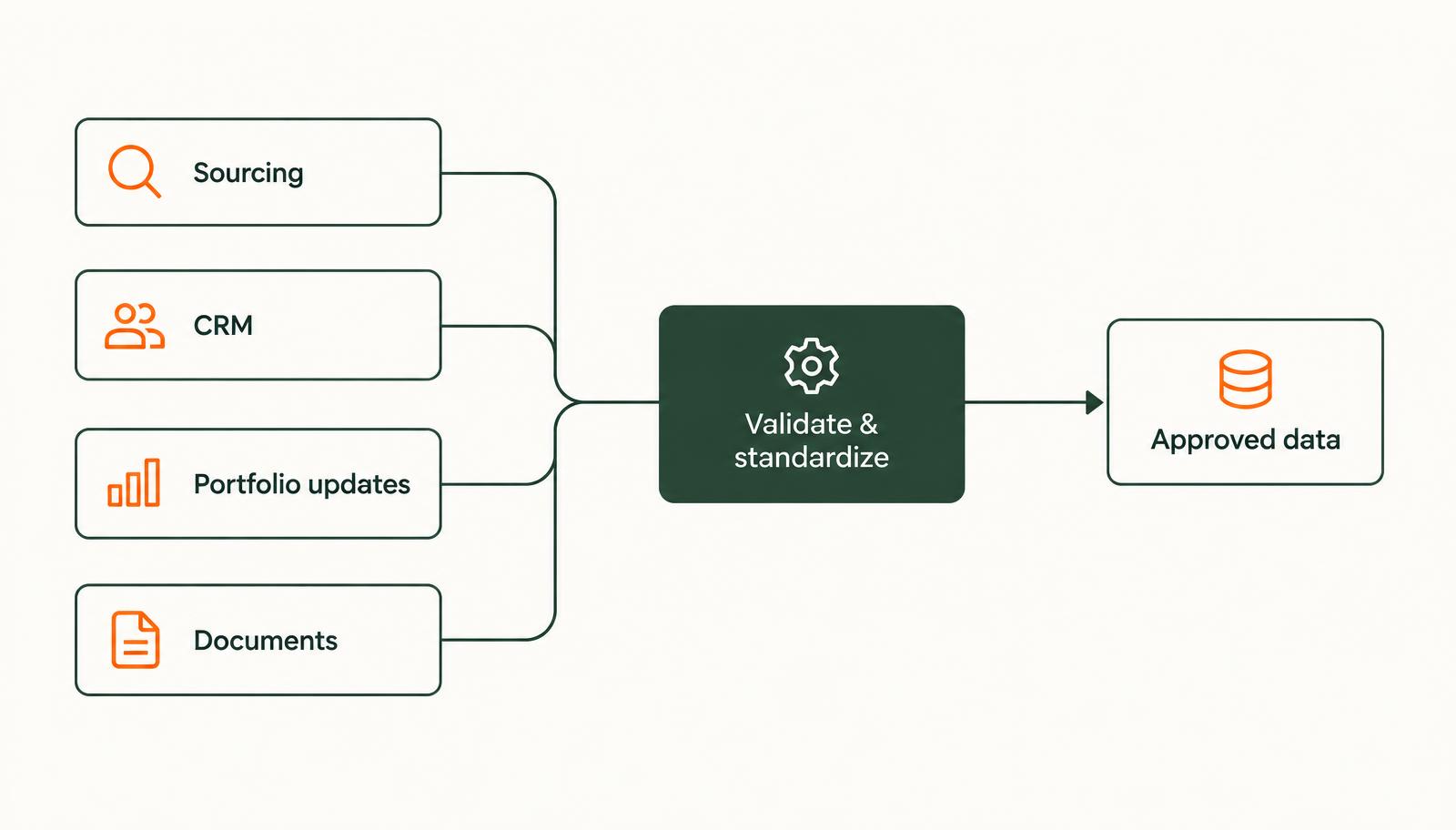
Venture capital data automation connects information across investment systems, standardizes it where appropriate, and reduces repetitive data handling while preserving accuracy, ownership, and review controls.
The objective is not to automate every activity.
It's to ensure that useful information reaches the right system and the right person without repeatedly being recreated.
This article examines the data automation platforms venture capital firms should evaluate, how the available technologies differ, and what it takes to build reliable data workflows across a fund.

What Is Data Automation in Venture Capital?
Venture capital data automation refers to using software to collect, transform, validate, synchronize, and distribute information across a firm's investment and operational systems.
It can involve straightforward integrations, scheduled data pipelines, document processing, or more sophisticated AI-assisted workflows.
For example, a VC firm might automate the process of transferring approved company information from a sourcing platform into its CRM.
Another firm might use automation to extract financial metrics from portfolio company updates and prepare them for review.
A third might connect approved reporting data with the documents used to prepare quarterly LP updates.
These processes have different requirements, but they share the same underlying objective: reducing manual work without compromising the reliability of the information.
What Can Venture Capital Firms Automate?
Common opportunities include:
- Company and founder data enrichment
- Duplicate company identification
- CRM record synchronization
- Investment pipeline updates
- Pitch deck information extraction
- Research document organization
- Portfolio company data collection
- Financial reporting checks
- Internal task notifications
- Historical investment information retrieval
However, not every task requires artificial intelligence.
Moving an approved company record from one application to another may only require a conventional integration.
Extracting inconsistent financial information from a PDF may benefit from document-processing AI.
Identifying whether two company records refer to the same business may require more specialized matching logic.
The right automation technology depends on the data problem, not whether the platform advertises AI capabilities.
Six Data Automation Platforms Venture Capital Firms Should Evaluate
Several established platforms can support venture capital data automation.
However, they belong to different software categories.
Some connect applications. Others specialize in enrichment, document processing, or enterprise data pipelines.
Understanding these differences is essential before comparing products.
| Platform | Primary Function | Potential VC Application | Main Consideration |
|---|---|---|---|
| Zapier | Application and workflow automation | CRM updates, notifications, document routing | Straightforward workflows and task-based costs |
| Make | Visual workflow orchestration | Multi-step data synchronization and conditional routing | Workflow complexity and error handling |
| n8n | Configurable workflow and AI automation | Custom integrations, internal data pipelines, AI workflows | Technical ownership and maintenance |
| Clay | Data enrichment and research automation | Company enrichment, founder information, record preparation | Data accuracy, coverage, and credit consumption |
| Workato | Enterprise integration and data orchestration | Cross-system integration, governed pipelines, operational automation | Implementation effort and enterprise requirements |
| FactSet Cobalt | Private capital portfolio data management | Portfolio document ingestion and structured financial data | Product scope, availability, and investment data requirements |
This comparison is based on publicly documented capabilities as of November 2026. It is not an independently tested performance ranking. Specific functionality, integrations, pricing, and deployment options should be confirmed with each vendor.
1. Zapier: Connecting Everyday Investment Applications
Zapier is a workflow automation platform that connects applications through triggers and actions.
For example, when a new record is created in one system, Zapier can trigger a defined action in another.
The platform supports a broad range of application integrations, webhooks, conditional workflows, and AI-assisted processing.
Its workflow automation documentation describes how application events can initiate multi-step processes.
Where Zapier fits VC operations
Consider a small venture capital firm using a CRM, Google Workspace, and a shared research repository.
When an associate approves a new opportunity, a workflow could create a research task, notify the responsible team member, and organize the relevant documents.
This can reduce administrative work without requiring a custom application.
Zapier is worth evaluating when a firm needs relatively straightforward integrations between commonly used applications.
What to evaluate
The firm should confirm whether its investment-specific software has a supported integration or accessible API.
It should also consider task consumption, how failures are handled, and whether the workflow can safely retry an operation without creating duplicate records.
A simple workflow may be easy to maintain.
A large network of interconnected automations may require more deliberate oversight.
2. Make: Multi-Step Automation With Conditional Logic
Make provides a visual environment for building workflows across applications and data sources.
Its workflows, called scenarios, can include conditional routes, data transformations, and error-handling procedures.
This can be useful when information needs to move through several processing steps.
Where Make fits VC operations
Imagine a fund receiving incoming investment opportunities through a submission form.
A workflow could:
- Receive the submitted information.
- Check whether required fields are present.
- Search for an existing company record.
- Route potential duplicates for review.
- Prepare a new CRM record when appropriate.
- Notify the assigned investment professional.
The process combines several activities into one defined workflow.
Make's documentation explains how its webhooks and scenario triggers can initiate automation when new information becomes available.
What to evaluate
More sophisticated routing also introduces more opportunities for failure.
What happens if the CRM is temporarily unavailable?
Will the workflow retry?
Could the same company be added twice?
Will the investment team receive an alert?
These questions matter more than the visual appearance of the workflow builder.
Make may be suitable for firms with moderately complex processes that want flexibility without developing every integration from scratch.
3. n8n: Configurable Automation With Deployment Flexibility
n8n provides workflow automation capabilities that combine application integrations, custom processing, and AI-related functionality.
It supports both hosted and self-hosted deployment options.
This makes it relevant for organizations that want more control over how their workflows are developed and operated.
According to the n8n documentation, the platform supports customizable workflows, custom nodes, and self-hosted deployments.
Where n8n fits VC operations
Consider a venture capital firm that wants to retrieve approved research documents, extract defined information, and prepare a structured screening record.
The process may involve:
- Retrieving documents from an approved repository
- Extracting company information
- Validating required fields
- Applying matching logic
- Preparing an AI-generated summary
- Sending the result for human review
n8n could provide the orchestration environment for such a workflow.
This approach may appeal to firms with internal technical resources or an external development partner.
What to evaluate
Deployment flexibility does not automatically mean a system is secure or compliant.
A self-hosted environment still requires infrastructure maintenance, credential management, monitoring, updates, and appropriate access controls.
The firm must also decide who owns the workflows and who responds when something fails.
For teams without technical support, maintenance requirements may outweigh the benefits of greater control.
4. Clay: Company Enrichment and Data Preparation
Clay focuses on data enrichment, research automation, and workflows that combine information from multiple providers.
It is particularly relevant when a firm wants to improve incomplete company or contact records.
Clay's enrichment capabilities include a method known as waterfall enrichment.
This allows a workflow to query data providers in a defined sequence rather than relying on a single source.
Its waterfall enrichment documentation explains how users can configure provider sequences and control when enrichment steps run.
Where Clay fits VC operations
Consider a venture capital firm maintaining a database of companies within its investment thesis.
Some records contain only a company name and website.
Others are missing founder information, company descriptions, or relevant market details.
An enrichment workflow could help populate selected fields using permitted data sources.
The investment team could then review the information before deciding which companies warrant further research.
What to evaluate
Enrichment is not the same as verification.
Different providers may report conflicting information about a company's size, industry, or financing history.
A workflow that automatically selects the first available answer may introduce inaccuracies.
Firms should evaluate data provenance, freshness, permitted usage, record-matching accuracy, and the cost of repeated enrichment.
Clay can support company intelligence workflows, but it should not be treated as an authoritative fund accounting or investment decision-making system.
5. Workato: Enterprise Integration and Data Orchestration
Workato provides application integration, workflow automation, and data orchestration capabilities.
Its platform is designed to connect information across enterprise applications and support more structured operational processes.
Workato's data orchestration documentation describes capabilities for extracting, transforming, and loading information across applications, databases, and data warehouses.
It also documents workflow monitoring and reusable components.
Where Workato fits VC operations
Workato may be worth evaluating for larger investment organizations managing multiple funds, applications, and operational teams.
For example, a multi-fund manager may want to coordinate information across its CRM, internal databases, portfolio reporting tools, and other approved systems.
The firm may also require standardized monitoring and controls around how these processes operate.
What to evaluate
The benefits of a more extensive integration platform need to be considered against implementation requirements.
A smaller fund may not need enterprise-level orchestration to support a handful of straightforward automations.
Firms should evaluate available connectors, implementation costs, technical support requirements, and the features included in their proposed subscription.
Not all Workato capabilities are available on every plan.
6. FactSet Cobalt: Automating Private Capital Portfolio Data Collection
FactSet Cobalt addresses a more specialized investment data problem.
It focuses on portfolio monitoring and managing private capital investment information.
In 2026, FactSet announced AI Doc Ingest for Cobalt, designed to help private capital managers extract structured data from portfolio company documents.
The company's AI Doc Ingest announcement describes a workflow for extracting, validating, and publishing information from documents into Cobalt.
The capability was initially announced as a beta, so firms should confirm its current availability and commercial terms.
Where FactSet Cobalt fits VC operations
Consider a growth-stage investment firm receiving financial statements and operating reports from multiple portfolio companies.
Instead of manually transferring selected information from each document into a monitoring system, the firm may want a structured document-ingestion process.
A specialized platform can be relevant when portfolio financial data is the main automation requirement.
What to evaluate
Firms should confirm the supported document types, metric definitions, validation procedures, and required review steps.
They should also determine whether the platform fits their broader portfolio monitoring requirements.
A specialized portfolio data system is not a direct replacement for a general-purpose automation platform such as Zapier, Make, or n8n.
Which Data Automation Platform Fits Different VC Requirements?
There is no universal choice because the platforms solve different problems.
The most useful starting point is identifying the type of data workflow the firm needs to improve.
| VC Requirement | Platforms Worth Evaluating | Why |
|---|---|---|
| Basic CRM and application automation | Zapier, Make | Connect applications and coordinate recurring actions |
| Multi-step workflows | Make, n8n | Conditional processing, transformations, and workflow logic |
| Company and founder enrichment | Clay | Structured enrichment using multiple providers |
| Custom AI-assisted pipelines | n8n, Workato | Coordinate data sources, processing, and review stages |
| Enterprise integration | Workato | Cross-system orchestration and operational controls |
| Portfolio financial document ingestion | FactSet Cobalt | Specialized private capital data collection |
| Fund-specific integration requirements | Custom development using suitable infrastructure | Adapt workflows around existing systems and investment processes |
The platforms listed are candidates for evaluation, not guaranteed integrations with every venture capital application.
A firm should confirm the required connectors and permissions before selecting a provider.
The Real Challenge: Moving Data Without Losing Its Meaning
Automating information transfer is relatively straightforward when every system uses the same definitions.
Venture capital firms rarely operate in that environment.
A company may appear under different names.
The same financial metric may be reported using different calculation methods.
A founder may provide an estimate that later becomes outdated.
Two applications may contain information from different reporting periods.
If these differences aren't addressed, automation can spread inconsistencies across the firm.
Company Identity and Duplicate Records
Consider a startup operating under a trading name while its legal documents use a different registered entity.
The sourcing platform may identify the trading name.
The CRM may contain the registered company name.
An investment document may refer to a subsidiary.
If an automated system relies only on company names, it could create duplicate records or associate information with the wrong business.
A reliable process should consider stable identifiers where available, relevant domains, legal entities, and documented matching rules.
Potential matches should be reviewed when confidence is insufficient.
Metric Definitions
A portfolio company may report recurring revenue differently from another business.
For example, one company may exclude certain usage-based revenue from ARR, while another includes it.
Automating both figures into the same field does not make them directly comparable.
A useful pipeline should preserve the original metric definition and reporting period.
Data Freshness
Suppose a company reported a $2 million cash balance in March.
A separate document contains an updated balance from June.
An automated process that retrieves the March figure and presents it as current could create a misleading investment summary.
The workflow must account for reporting dates and approval status.
Data automation should preserve context, not simply move values between fields.
What a Reliable VC Data Pipeline Should Include
Before introducing automation, a venture capital firm should understand how information will be collected, processed, and used.
A dependable data pipeline typically requires several components.
1. Approved Data Sources
Identify which systems and documents can provide information.
For example:
- Sourcing platforms
- Investment CRMs
- Approved company databases
- Research repositories
- Portfolio company reports
- Fund accounting systems
Access should be limited to the information necessary for each workflow.
2. A Clear System of Record
Determine which application maintains the authoritative version of each category of information.
A CRM may own the firm's investment pipeline status.
A portfolio monitoring system may maintain reviewed company operating metrics.
A fund accounting system may maintain official financial records.
This does not require every piece of information to live in one database.
It requires clear ownership of important fields.
3. Data Transformation Rules
Information from different sources may need to be standardized.
For example, a company record may need consistent sector classifications, geographic identifiers, and date formats.
Financial information may require mapping into the fund's approved reporting structure.
These transformations should follow documented rules.
4. Validation and Exception Handling
The system should identify information that does not meet defined requirements.
Examples include:
- Missing mandatory fields
- Duplicate company records
- Conflicting financial figures
- Unexpected data formats
- Unsupported source documents
- Outdated reporting periods
Errors should not automatically become accepted records.
The process should determine when an issue can be resolved through established rules and when it requires human review.
5. Controlled Synchronization
Before writing information into another system, the pipeline should check whether a corresponding record already exists.
It should also define which fields can be updated and whether the operation requires approval.
This matters because retrying a failed workflow can sometimes create duplicate actions.
A reliable implementation should support safe retries and appropriate recovery procedures.
6. Source History and Auditability
Investment teams should be able to understand where material information originated.
For AI-assisted workflows, this includes preserving relevant source references and the transformation steps that produced an output.
The NIST AI Risk Management Framework provides a broader basis for evaluating information integrity, transparency, and AI governance.
For venture capital firms, these principles are particularly relevant when automated information is reused in investment research or investor reporting.
Example: Automating Company Intake From Sourcing to CRM
Consider a hypothetical seed-stage venture capital firm focused on enterprise software.
The firm discovers companies through multiple channels and maintains its investment pipeline in a CRM.
Its associates regularly spend time entering company information, checking for duplicates, and preparing initial research records.
The firm wants to automate part of the intake process.
A reliable workflow could follow these stages.
| Stage | Automated Activity | Control |
|---|---|---|
| 1. Intake | Retrieve the new company record | Confirm approved source |
| 2. Identification | Check for existing company records | Review uncertain matches |
| 3. Enrichment | Retrieve permitted company information | Preserve provider and retrieval date |
| 4. Classification | Organize company characteristics | Verify ambiguous classifications |
| 5. Validation | Check required fields and inconsistencies | Flag incomplete information |
| 6. CRM preparation | Prepare a new or updated record | Prevent duplicates and unauthorized overwrites |
| 7. Review | Present the record to the associate | Human approval |
| 8. Follow-up | Trigger the next approved task | Maintain an execution record |
This approach reduces repetitive preparation without automatically deciding whether the company is an attractive investment.
The distinction matters.
An automated system may identify that a company operates in enterprise software.
But that information alone does not establish investment thesis alignment.
The fund still needs to determine whether the opportunity deserves attention.
For a broader examination of investment pipeline workflows, see our article on AI deal flow management for venture capital firms.
Data Automation for Portfolio Monitoring
Data automation becomes particularly important after a company enters the portfolio.
Investment teams need consistent information about company performance, financing activity, and operating developments.
However, portfolio companies rarely report information in identical formats.
Some provide structured spreadsheets.
Others submit board presentations or financial statements.
A portfolio data pipeline can help organize these inputs.
But financial information requires stricter controls than ordinary CRM enrichment.
Example: Quarterly Portfolio Data Collection
A VC firm receives an update from a portfolio company.
The document contains reported revenue, cash balances, monthly spending, and several operating metrics.
An AI-assisted system could extract the relevant information and associate it with the company and reporting period.
The system might then compare those figures with the previous approved period.
If the cash balance differs materially from another document, the workflow should identify the discrepancy.
It should not silently select the most convenient number.
The investment team would review the exception before the information becomes part of its approved portfolio records.
This is where the difference between data automation and financial validation becomes especially important.
A pipeline can move information successfully while still moving incorrect information.
Our article on AI tools for VC portfolio management examines how firms can organize company reporting and identify developments that warrant attention.
Should VC Firms Use APIs, Webhooks, or AI Agents?
These technologies solve related but different problems.
APIs
An API allows software applications to exchange information through defined interfaces.
For example, an investment CRM may provide an API for retrieving or updating company records.
APIs are useful when a workflow needs predictable access to structured information.
Webhooks
A webhook allows one application to notify another system when a defined event occurs.
For example, a CRM may send an event when a deal changes stages.
This can trigger an automation without requiring the receiving system to check repeatedly for changes.
However, webhook delivery and processing still require error handling.
Scheduled Data Pipelines
Some information doesn't need to move immediately.
A fund may only need to synchronize selected portfolio information daily or prepare reporting inputs at the end of each month.
Scheduled processing may be simpler and more reliable than building unnecessary real-time integrations.
AI Agents
AI agents can coordinate tasks that involve information retrieval, document processing, and other defined actions.
For example, an agent could help retrieve approved research documents and prepare a structured summary.
But an AI agent is not inherently a replacement for an API or integration platform.
It typically depends on those underlying connections to access or update information.
For predictable tasks, conventional workflow automation may be more appropriate.
For tasks involving variable documents or unstructured information, AI-assisted processing may provide additional value.
The choice should follow the task.
The Hidden Costs of Venture Capital Data Automation
Software subscription fees are only one part of the cost.
A workflow that appears inexpensive to configure may require substantial maintenance if the underlying applications or data structures change.
A firm should evaluate several cost categories.
| Cost Category | What to Consider |
|---|---|
| Platform subscription | Base plan, users, available features |
| Usage-based charges | Workflow executions, tasks, operations, API calls |
| Data enrichment | Provider credits and repeated lookups |
| AI processing | Model usage and document processing costs |
| Integration development | Custom connectors and configuration |
| Maintenance | Changes to APIs, data fields, and workflows |
| Monitoring | Error handling, alerts, and execution review |
| Data validation | Human effort required to verify information |
| Security | Access controls, credential management, and infrastructure |
| Migration | Exporting workflows and records when changing providers |
Automation Can Increase Costs When Data Quality Is Poor
Consider a company database containing thousands of duplicate or incomplete records.
If a fund introduces automated enrichment before addressing those problems, it may pay to enrich the same company multiple times.
The process can also introduce conflicting information into different records.
Improving record quality before scaling enrichment may be more economical than automating the existing database without changes.
Maintenance Responsibility Matters
A workflow created by an associate may initially work well.
But what happens when that employee leaves?
Who understands the integration?
Who has permission to modify it?
Who receives alerts when it fails?
An automation without an accountable owner can become another operational problem.
For larger firms, ownership and maintenance should be defined before the workflow enters regular use.
How to Evaluate Data Automation Software Before Committing
A meaningful evaluation should use a real workflow rather than an isolated product demonstration.
For example, a venture capital firm could select a representative sample of incoming company records and test the complete intake process.
The evaluation should measure more than whether the records successfully move between systems.
| Evaluation Criterion | Question to Answer |
|---|---|
| Integration coverage | Can the platform access the required systems? |
| Data accuracy | Are important fields transferred correctly? |
| Duplicate handling | Does the process avoid creating duplicate records? |
| Error recovery | What happens when a workflow fails? |
| Source traceability | Can users identify where information originated? |
| Permissions | Can access and write actions be restricted? |
| Human review | Can sensitive changes require approval? |
| Operating cost | What does the complete workflow cost? |
| Maintenance | Who can troubleshoot and modify the process? |
| Portability | Can the firm export relevant workflows and data? |
Test the Difficult Cases
A successful demonstration using clean sample data does not establish that a platform will work reliably with real investment information.
The firm should test scenarios such as:
Duplicate company records: Two records appear to reference the same startup.
Conflicting information: Different data providers report different employee counts or financing histories.
Incomplete records: A company has no verified website or legal entity identifier.
Unavailable systems: The CRM API temporarily fails.
Changed data structures: A portfolio company submits a report using a different format.
Restricted information: A workflow attempts to access information beyond its permitted scope.
The platform should handle these cases predictably.
In some situations, the correct action will be to stop the workflow and request human review.
That is a feature of a reliable system, not a failure of automation.
When Does Custom Data Automation Make Sense for VC Firms?
Existing automation platforms can address many common requirements.
A venture capital firm with straightforward CRM synchronization needs may not require custom development.
However, more specialized workflows may depend on the firm's internal investment criteria, data structures, and review procedures.
When Standard Platforms Are Sufficient
Existing platforms may be appropriate for:
- Moving approved records between applications
- Routing notifications and tasks
- Performing routine data transformations
- Enriching company records
- Supporting standardized reporting workflows
The most important considerations are reliability, integration support, and total operating cost.
When Custom AI Workflows Become Relevant
A fund-specific system may be worth evaluating when information needs to be interpreted according to the firm's own investment process.
For example, a fund may want to combine company information from multiple approved sources, apply its screening criteria, and prepare a structured research record.
Another firm may want to organize historical research alongside new information while preserving the context of previous investment decisions.
A portfolio team may need to process company updates according to its own reporting definitions and exception rules.
These requirements extend beyond ordinary application synchronization.
The system must understand how information should be organized and when a human decision is required.
Our article on AI-first VC operations stacks examines the broader architecture needed to connect these systems across an investment firm.
How Sonexa Labs Approaches Venture Capital Data Automation
Sonexa Labs develops fund-specific AI models and agents around venture capital firms' investment strategies, approved information, and internal workflows.
Its approach differs from a general-purpose automation platform.
Rather than offering a standardized library of application integrations, Sonexa develops commissioned systems around defined investment and operational requirements.
The objective is to make information more useful within the firm's existing processes.
Building Around Existing Data and Workflows
Through Sonexa Labs' Tailored Solutions, venture capital firms can explore custom AI systems that support sourcing, screening, research, portfolio intelligence, and other operational activities.
For example, a fund may want to organize approved research from several repositories into a consistent screening process.
Another may need to extract information from company updates and prepare structured materials for investment team review.
The specific systems, integrations, and outputs would be agreed during the engagement.
These capabilities should not be confused with a prebuilt data integration product.
Fund-Specific Investment Data Processing
Sonexa's Screening & Investment Research offering addresses potential workflows that organize information around a fund's investment criteria.
A commissioned system could help collect approved inputs, prepare structured research, and identify information requiring verification.
For portfolio companies, Sonexa's Portfolio Intelligence offering addresses workflows involving company updates, approved metrics, and changes that warrant investor attention.
In both cases, the emphasis is on reviewable outputs and defined responsibilities.
Preserving Information Across the Firm
Data automation also creates an opportunity to make historical information easier to retrieve.
For example, a firm may want previous research, screening decisions, and investment memos to remain accessible when a company becomes relevant again.
Sonexa's Institutional Knowledge & Firm Operations offering addresses this category of requirements.
The relevant data sources, permissions, and system behavior would depend on the commissioned engagement.
The objective is not to replace the firm's existing CRM or accounting system by default.
It is to build an AI-supported workflow that fits the firm's processes and available information.
Conclusion: Automate the Data Work That Slows Down Investment Teams
Venture capital firms don't need another application simply because it offers more automation features.
They need information that moves reliably between the systems they already use.
Zapier and Make can support application-level workflows.
n8n provides greater flexibility for configurable integrations.
Clay focuses on company and contact enrichment.
Workato addresses more extensive integration and orchestration requirements.
FactSet Cobalt offers specialized capabilities for private capital portfolio data collection.
Each serves a different purpose.
The right choice depends on the firm's existing systems, technical resources, data requirements, and operating costs.
But selecting a platform is only part of the work.
Reliable data automation also requires clear systems of record, consistent definitions, source traceability, error handling, and appropriate review procedures.
Without those foundations, a firm may simply automate the movement of inaccurate information.
Sonexa Labs develops fund-specific AI models and agents around venture capital investment workflows, helping firms organize approved information and support repeatable research, portfolio, and operational processes.
Book a Demo to explore how tailored AI systems could support your firm's data and investment workflows.
Frequently Asked Questions
What are data automation platforms for venture capital?
Data automation platforms help venture capital firms collect, transform, synchronize, and organize information across applications. They can support CRM updates, company enrichment, investment research preparation, portfolio data collection, and other recurring workflows.
Which data automation platforms should venture capital firms evaluate?
Zapier, Make, n8n, Clay, Workato, and FactSet Cobalt are worth evaluating for different requirements. They are not direct substitutes: some focus on application integrations, others on enrichment, enterprise orchestration, or portfolio data processing.
What is the best data automation software for venture capital firms?
The appropriate software depends on the workflow. Zapier and Make may suit relatively straightforward integrations. n8n offers more technical flexibility, Clay specializes in enrichment, Workato supports enterprise data orchestration, and FactSet Cobalt addresses private capital portfolio data.
Can venture capital firms automate CRM data entry?
Yes. Automation can help transfer approved information into CRM records, enrich selected fields, and organize follow-up actions. Firms should establish duplicate-detection rules and review requirements before allowing automated systems to overwrite important data.
Can AI automate portfolio company data collection?
Yes. AI-assisted systems can extract information from company updates, financial documents, and other approved sources. However, material financial figures should be verified before they become part of the firm's authoritative reporting records.
What is the difference between data automation and AI automation?
Data automation includes moving, transforming, and validating information through defined processes. AI automation uses models to support tasks such as document extraction, classification, summarization, and information interpretation. Many workflows combine both approaches.
Do VC firms need custom data automation systems?
Not necessarily. Existing platforms can handle many routine integration requirements. Custom systems become more relevant when workflows depend on fund-specific investment criteria, unusual data structures, or specialized information-processing requirements.
Can automation platforms connect with venture capital CRMs?
Many automation platforms support CRM integrations, APIs, and webhooks. However, compatibility varies by product and subscription. Firms should verify the exact integration and supported actions before implementation.
How much does venture capital data automation cost?
Costs depend on platform subscriptions, workflow volume, enrichment credits, AI processing, custom integrations, and maintenance. The appropriate comparison is the total cost of operating a reliable workflow rather than the advertised monthly subscription alone.
What should VC firms automate first?
A practical starting point is a repeatable process with defined inputs and outputs, such as preparing new company records or organizing approved portfolio updates. The firm should test data accuracy, error handling, and human review requirements before expanding automation.
How does Sonexa Labs support venture capital data automation?
Sonexa develops commissioned AI models and agents around individual venture capital firms' workflows. Depending on the agreed scope, these systems may support investment research preparation, approved data processing, portfolio intelligence, or institutional knowledge retrieval.